From Big Bad Wolf to Level House:
In Conversation with Yama Seth, a Leading Force Behind the Indie Music Scene
Written by Aanchal Bordoloi
Edited by Sohaib Durrani
One word to describe my conversation with Yama: Goosebumps. This interview felt like a Godsend — a conversation between a stellar artist manager and an aspiring singer-songwriter. Through this interview, I got an opportunity to have a glimpse of the behind-the-scenes moments of some spectacular shows in the Indie scene. Yama has spoken in-depth regarding how she had initially started out, and her experiences and thoughts around the ever-evolving music scene in the country:
To begin with, could you please tell us a little bit about your work, and the vision with which you approach artist management?
I am Yama, and I started out working at Big Bad Wolf which is a Delhi-based agency that represented quite a few artists and bands. This was 10 years ago. I started with curating venues first at Big Bad Wolf and subsequently got into management which was for Vir Das’s Alien Chutney, which was Das’s comedy ensemble. I started touring with them and then got into 360 degree management with Parvaaz, which is a Bangalore-based band that I’ve been representing for quite a while now. Several more artists got added later, including Indian Ocean which has been active and releasing music for 35 years now and I represented them for 7 of those years which has been an important feather in the hat for me. I then moved out of Big Bad Wolf and started my own vertical, by the name of Level House. A couple of artists who were with me at Big Bad Wolf moved with me – Parvaaz, Parekh and Singh, Sameer Rahat, and some newer folks like Raman Negi and JBabe who’s the frontman of the F16s.
We’re just shy of completing 2 years with Level House and it’s a company that is under the umbrella of Skillbox. The parent company, Skillbox, is a ticketing platform, and Level House is sort of the management vertical of it. Apart from management per se, I’ve also curated a few festivals in the country including Ridermania which is a Royal Enfield IP that happens every year in Goa. Primarily, my focus for quite a while now has been artist management.
In terms of approaching artist management, it’s a very specific and niche roster that I have, and the reason I have these people is that I have never represented any artist whose music has not moved me individually, and this plays a huge part in being able to add on to their trajectory when you really love what they do. I don’t need Third Party motivation in my life to be able to keep me going because I really appreciate the music and I really want to keep working towards it everyday. The other thing that seems to be the theme, now that I have been doing this for 10 years, that kind of stands out, and is that the reason I call my agency LEVEL HOUSE is that I want to create a level-playing field. I have seen that in quite a few agencies in the world that whenever there is an A-lister, all the attention is focussed there and for us we did not want to focus all our resources towards any one particular artist and I wanted to make it a level playing field where all the artists receive the same kind of attention and ensure in-depth detail and strategizing. We want to build this kind of ecosystem within our agency and this also goes for our tour managers on the staff-end of things. All of the people that work at Level House don’t only think about the growth trajectory of one particular artist. It’s a collective effort. This has been a central theme in how I look at artist management. It’s also about the younger new-comers with the same intention that you would look at anybody else. This is largely the ethos of it.

I appreciate this! It is beautiful to note that at Level House, an equal amount of importance is placed on the growth of every single artist on board – instead of only focusing on artists who are well-established in the scene.
What qualities in an artist/band do you look for before signing them at your respective artist management companies?
I find this question a little obnoxious. Between you and me, you’re the artist right? I don’t know how to play a song/play the guitar/sing or anything that comprises this beautiful thing we call music. So how is it and in what kind of parallel universe, do I as a manager get to pick and choose the artists I work with? In the hierarchy of things, no matter which stage the artist is in, I feel the artist has the upper hand and more often than not, in my case, it’s always the artists who have approached me.
I am not a label that does A&R . I work in management which is basically a version of enhancing the artist’s pre-existing vision. So, I don’t go around looking for qualifications in an artist, because honestly, I don’t think I have the authority to. It’s lucky that the work I have put out with different artists has been visible and that artists have reached out to me themselves. I have somebody as seasoned as Blackstratblues on my roster and there is no way I can tell you what quality it is that I look for in Blackstratblues. So there is no sort of parameter that I measure them with.
The one thing that I do really care about in any artist is that they have to have some kind of an urgency and focus towards what they do. To break it down with an example, I don’t think I work well with artists who have their hands in 50 million pies…you know…and music is one of the pies. I’ve always worked best when my intention is met with the artist’s, who is very focused about doing just this thing. I really need the artist to have a clear vision that – this is my priority. This helps to really pave the path for me to work in the best form possible. Instead of a qualification, it’s more of a mindset thing that we share with the artist.
Thank you for saying this. It is good to know that it is essential for artists to have a clear vision and a sense of focus and urgency towards their artistic pursuits. I feel that this is important in a time where the number of Instagram followers and Spotify listeners seem to matter more than artistic integrity and music quality.
Thankfully I have been able to stay away from “influencer music”, for the lack of a better word. Hopefully I can stick it out without it. What I see is that a lot of these people who have millions of followers don’t have the same ticket-selling capacity. I say this with great pride that nobody in my roster has that issue. You have come to my shows and seen the crowds…
Yes! (I have attended shows of Parvaaz and Parekh and Singh in Fandom, Bangalore and in fact opened for Parvaaz too)
I want to stick in this phase and see how long I can go on with being a purist in music, I guess.
That’s really beautiful!
I understand that factors such as how many tickets an artist is able to sell and whether they would be able to fill venues with a good audience is essential, artistic integrity should not be lost sight of. I agree with you; I have attended shows of both Parvaaz and Parekh & Singh. They always manage to get a very good crowd and the venues have always been jam-packed with fans.
Looking at current musicians in the Indie scene who have become very accomplished and successful in terms of being able to perform their music and reaching large audiences, I’m sure it would have taken years of hard-work for these brilliant artists to finally get the spotlight. With the rise of an ever-growing interest in the Independent music industry such as the growing number of artist management companies and music conferences, do you think that maybe we could speed up this process of getting better at identifying potential in artists and contributing to their growth in the early stages?
Okay, so this is sort of a meandering point of view but let me tell you something.. 5-6 years ago, pre-Covid, there wasn’t this kind of organisation in the music industry. What I really do appreciate, is that now there are these conferences where you get access to publishers…where you can access labels as young artists as well as performing rights societies, copyrights societies, brands, live event curators, festival curators, ticketing partners… Musicians can now get access to them and understand this world in depth a little more, but I don’t think that this directly translates to an artist blowing up quicker. I have these kinds of conversations with people I represent on a daily basis. The reason it has taken maybe 6-7 years for Bloodywood to get to where they are now…or rather 10 years is a good thing. This is just a point of view and of course people see this differently, but to me, when I see music that is getting popular, let’s say through Instagram, that’s a quick process, in terms of what you’re asking?
Yes
This quick process is also quick to die. There’s a peak and there’s a fall. Songwriter 1 is replaced by Songwriter 2 on Instagram, within a matter of 8-10 months and all that is remaining is basically a one-hit-wonder who basically peaked on the algorithm for like a couple of months and then their tenure is over. Some of them are so young that they haven’t really had a chance to understand the identity they want to build as a musician, before it comes and goes. I turned 33 in March so maybe you can call me old-school about this but I feel like the people who’ve taken 10 years; their career is not going to go away and maybe their music would still be relevant, even after 10 more years. It’s like the difference between 3D printing something vs. building it block by block. The latter is always what I go for because I know that it will outlast everything. A lot of my artists and I, we talk and joke about this and say that this is the hill we die on, because this is what they want to do for the rest of their lives.
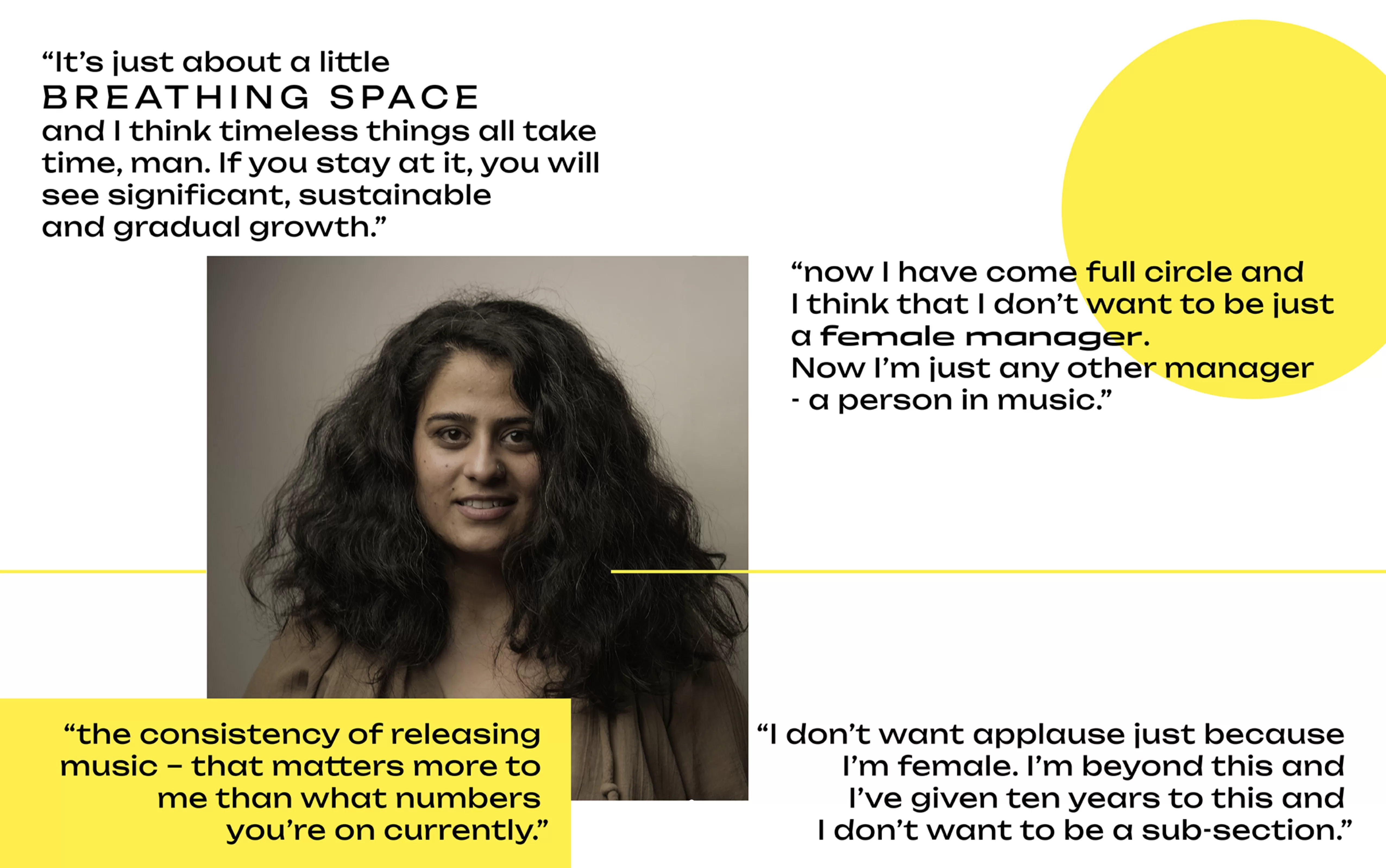
I don’t know if I want to quicken the process at all. In fact, I was talking to a very young musician yesterday who’s a 22-year old pianist and composer (Manan Mehta), who was also wondering “ki yeh jaldi kaise ho sakta hai…”(how can the process happen quicker). I tried to tell him that jaldi karne ki zaroorat kya hai (what’s the point of quickening the process)? It’s just about a little breathing space and I think timeless things all take time, man. If you stay at it, you will see significant, sustainable and gradual growth. I would rather take the trajectory of a Peter Cat Recording Co. , than artist X (I wish I could name them).
You have also sort of answered the next question which is –
When you are looking at signing artists, do the numbers really matter? – as in the number of Spotify listeners, Instagram followers? What does an artist need to do/work on to show their promise and potential in delivering good performances and honing their craft?
The one-word answer for me is CONSISTENCY. It doesn’t matter how many numbers you’re already sitting on. What does matter is how consistently have you put out music, how much you’re working on, do you really have material to show, in terms of your work and effort, and that’s how I look at it, so the one factor to sum it up, is the consistency of releasing music – that matters more to me than what numbers you’re on currently.
International acts such as Coldplay, Dua Lipa and Ed Sheeran have now begun to add India to their world tours. What implications would this have for the Indie scene in our country?
Bigger festivals like Lollapalooza etc. coming to India has a much bigger impact on us independent musicians directly because, there we get to see a line-up which consists of independent musicians. For big names in general, and stand-alone concerts when you talk about Coldplay or something… to me, while it is a great experience and I love that it puts India on the map…as long as independent musicians are not kind of associated with it and opening for them directly, there’s no such impact. But yes, the fact that the scale of production that we couldn’t afford in this country maybe even 5 years ago is now possible, and the world touring circuit is looking at India as a market has a huge impact on us. Just in terms of consumer choices…I get to see absolutely niche and beautiful names that I never thought I’d see live, like Glass Animals or Ben Howard, all these people coming to India is a huge thing. I feel like it has put us on the map as a touring country and I really like it when independent talent is being showcased for artists like them (international acts ). It definitely is a really good thing.
Would you have any advice for aspiring singer-songwriters looking at getting signed?
See, signing is 2 things right? One is being signed by a label, and a management. So I don’t think that people who have started out want to seek management that early on until they’re able to sustain themselves. You don’t need a manager until you’re able to sustain yourself because a lot of the time, artists don’t understand that the managers also kind of have a sustainable income right? So, if you’re not able to support yourself, how do you think you’ll be able to do that for a manager? So from management I’d say that you could probably sit it out until your career has taken decent shape and when you’re making good money to be able to shell out 15 percent of it. For label signing, it’s a very individualistic choice. If people do want to get signed to a label, making music that is in line with the label’s ethos and catering to their listenership, and being able to show some kind of marketing potential..like for an artist to not only play intimate shows, but also having the prospect of making an anthem-y song and integrating with various brands etc. So when a label sees scalability and openness in an artist like that, that’s when they’re completely interested.
How important are regional languages in music? We are aware that the film industry seeps into almost every aspect of our lives, from a socio-cultural perspective. As is the case in Karnataka, a large portion of the Indian population is yet to expand their listenership to songs written in English.
With independent music, I think you’re already aware that there is probably 2-5 percent of the country’s listeners that we’re really catering to. It’s mostly A towns – people who look at counter-culture, and people who have the means to look at counter-culture…people who have basically got the luxury of exploring art.
I remember doing a show in Nepal and realised that people there, show up for the biggest and smallest of artists, that travel from anywhere across the world and in any language they sing in, because they’re not kind of bogged down by this thing called Bollywood. There’s nothing else to hear except independent music. So then the culture completely changes and everybody is hungry to consume new music and experiment. Their taste in musicality there is infinite times superior to ours. In our country, because of Bollywood music, there is a very evident shift in political preference in our country so we have landed in a soup where you’re basically either speaking Hindi or you’re snubbed. But here is the silver lining –
I represent a band that sings in Kashmiri, and lives in Karnataka, and sees swarms of people showing up to their concert. There is another band in my roster that plays only instrumental music, and they still see swarms of people attending their shows in cities like Bangalore and Mysore. So, yes, you’re right about the things that don’t work but there’s somehow also things that work. When you build on truly growing your fanbase and curating your shows, curating them in a place that has consistently hosted credible artists, there is a way to thrive. We must not ignore the fact that we do have artists like Hanumankind, Peter Cat Recording Co. that are blowing up across the world. It’s not as sad as it used to be a while ago. It’s all good for us. Maybe you don’t even like Hanumankind’s music, but in the larger scheme of things, when you think of the fact that he blew up and he’s from Kerala, sings in English and the world is giving him the ear, it is good for all of us. So hopefully, when things like this happen and when prime ministers host artists like this, it lifts all of us up. It brings hope that maybe the future’s better. So, I’m not all pessimistic about it.
How do we work on making the Independent music industry more inclusive and accommodating of newer and fresher talent? For example, adding newer names to festival line-ups.
I don’t believe in representation for representation’s sake. Let’s say, there’s a line-up for a Rock music festival with artists that are predominantly male. I wouldn’t want to sort of fight towards… Just for the sake of representation, put in a female artist on the line-up; but what I do feel (even if it doesn’t suit the brief of the festival) and support is the idea that it has to open up to more communities that are not based in these A-towns and not kind of inherently privileged. To simplify this, basically instead of representation because of gender I prefer going with representation of class. It’s been a problematic view for a lot of people that I say this, and I am as staunch a feminist as they come, but I do want to say that the problem of class in India is bigger than the problem of gender. Which is not to say gender is not a problem but making exceptions in art for the sake of gender is a slippery slope. Right now independent music is full of artists with class privilege and I think it needs to be on the radar for people who are gatekeeping the culture for specifically gender representation that others are struggling too.
Venues that curate are so hell-bent on curating acts that sell tickets. 99.9% of musicians who could be really good for building a community, are not being programmed. Venues need to have a little more risk appetite where they’re able to host talent which is up and coming. Find a financial model, that may mean you get paid less, but find a way to accommodate and host talent that is good versus acts that get curated solely because of ticket-selling capacity. Otherwise, they’re going to saturate. We can’t always keep rotating in the same little kitty of musicians. Inclusivity is the need of the hour.
It is nice to see so many women taking up crucial roles in the music business. We would love to hear a bit about your personal journey as artist managers in this industry and if there were any roadblocks you faced that felt unique to you.
It’s funny, this is putting me in such an existential spiral. 10 years ago, this question was the thing that people asked me the most, and I loved answering this. I used to have a lot of angst about this. Now, it has completely changed shape. When I started out in 2015, there was no woman manager. There were Bollywood agents who weren’t touring exactly but were doing bookings. Apart from that there were no women managers. There were zero women working on the tech and production front. A touring female manager was not to be found.
Then gradually, a few more people started coming in, making it safer and interesting. Now it is pretty solid to see. I remember, when I was just about to leave Big Bad Wolf, and was looking for tour managers, I couldn’t find a single female tour manager. Thankfully, things have changed in a big way for me. So much so that now I have come full circle and I think that I don’t want to be just a “female manager”. I don’t want to have that tag anymore. Now I’m just any other manager – a person in music. Building an identity around my femininity is not a conversation I can have with everyone. I don’t want applause just because I’m female. I’m beyond this and I’ve given ten years to this and I don’t want to be a sub-section. It’s a little nuanced that way, now that I’ve grown up. It’s still kind of endearing when I see a new artist being represented by a younger female. I want to see what she does with that. I want to kind of sit in the periphery and ask if there’s something I can do to make it more fun for you. It’s been quite interesting but by no means am I the only one anymore and I feel good about it. It’s cool to not be the only one anymore!