Introspective Soundscaping: A Conversation with KillZen
Written by Anchal Sethi
Amidst deep and introspective exploration of dark futuristic-dystopian fantasia between two electronic musicians, Abhishek Chaturvedi and Anannya Gupta, KillZen was born. In this conversation with Anannya, we talked about their highly anticipated five-year journey to their debut at the Magnetic Fields Festival in 2024, what the pandemic-era exploration looked like, and intentionality behind album formats and track titles that help establish their artistry through to the listeners. “Music asks for presence. At the very least, it deserves your full attention, because that’s what the artist gives when they create it.”
How did the Magnetic Fields Festival Set come into place—from the spark of an idea to what is now a full-fledged 12-track album?
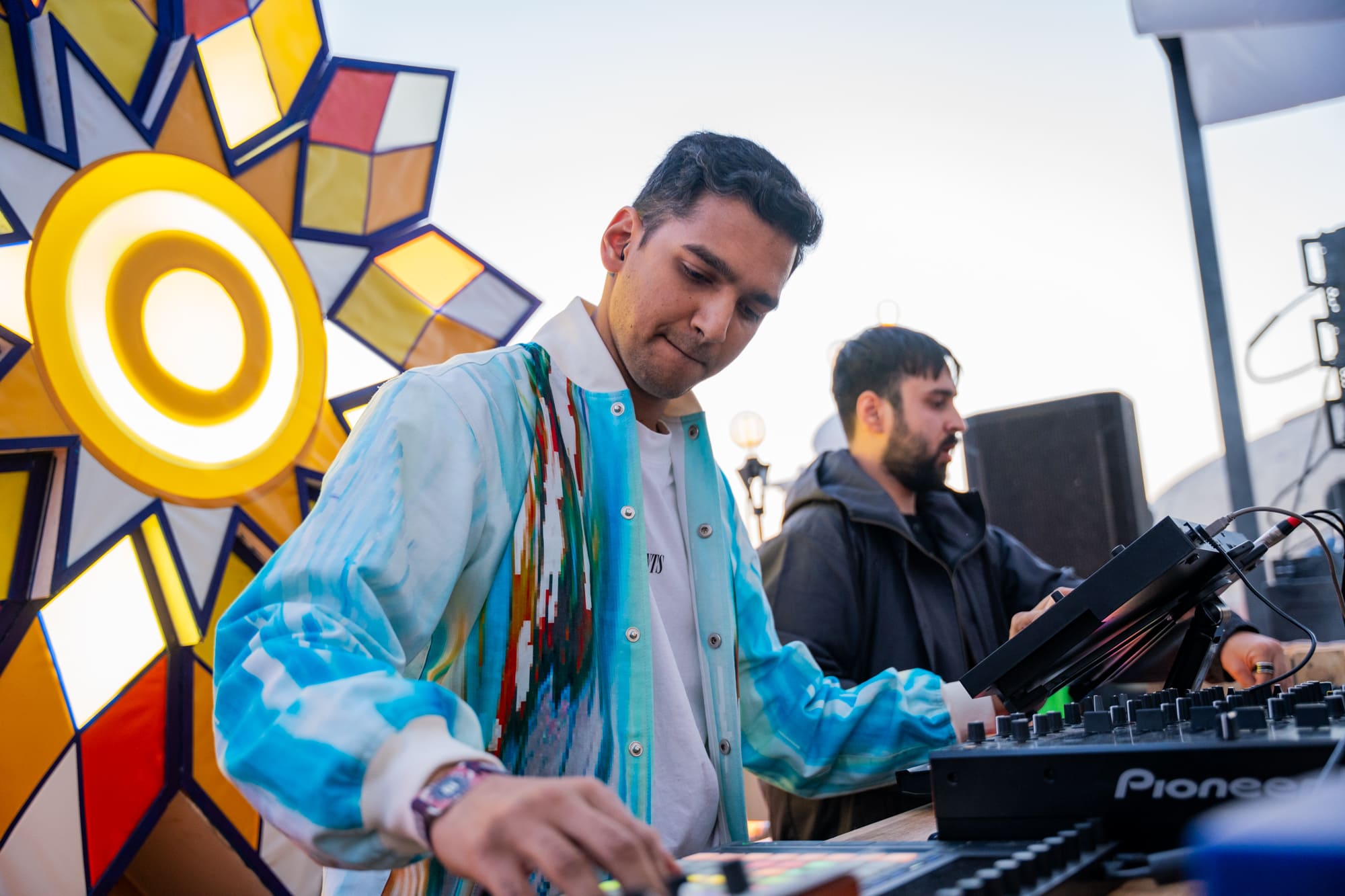
It began quietly in 2019, when my sister, then senior manager for client servicing and production with a Magnetic Fields partner, had introduced us to the festival’s programming head at the official festival afterparty. That simple introduction grew into years of exchange: we shared every release, performance iteration, and milestone, while he offered sharp, honest feedback that shaped our growth. During the pandemic, while many artists struggled to stay afloat, we locked ourselves away and focused on creating, emerging with enough material for seven albums. In 2022, the long awaited Magnetic Fields offer finally arrived, only to be cancelled due to a non-compete with DGTL festival, who had booked us for the same weekend. 2023 became a year of introspection and refinement. We immersed ourselves in spatial audio, ambisonics, and immersive performance design, fundamentally reshaping our live approach. At long last, 2024 turned into a full circle moment when we were invited to perform at Magnetic Fields Festival’s 10 year celebration on 7th December. The set itself was a carefully mixed curation of material written between 2020 and 2024—an amalgamation of tracks that had already proven themselves on stage, pieces that had lived quietly in the vault, and music written specifically for that evening.
The full circle moment is such a beautiful thing to note! How do you find the crowd perception while navigating the Indian electronic music scene? Also, seeing someone compliment your soundcheck in the MFF’24 aftermovie must have been thrilling—how does it feel to be recognized like that?
Our music and performance iterations naturally attract a niche audience, but once people step in, they tend to stay for the longer game. Music is subjective, so it may not be for everyone’s taste or may seem too introspective. Still, after five years of refining and performing multiple iterations of this project, we were confident we would do justice to our debut. And of course, that individual showing genuine enthusiasm for our soundcheck was unexpectedly validating, and it helped calm our nerves as the moment drew closer!
From your Magnetic Fields Festival set, I saw quite a few posts mapping your experience, some heartwarming and some challenging. One such post was about the soundcheck struggle, which seemed detrimental to all your gear, but proving to be worth it at the end of the day. Can you elaborate more on your soundcheck experience, and also share any more highlights from that day?
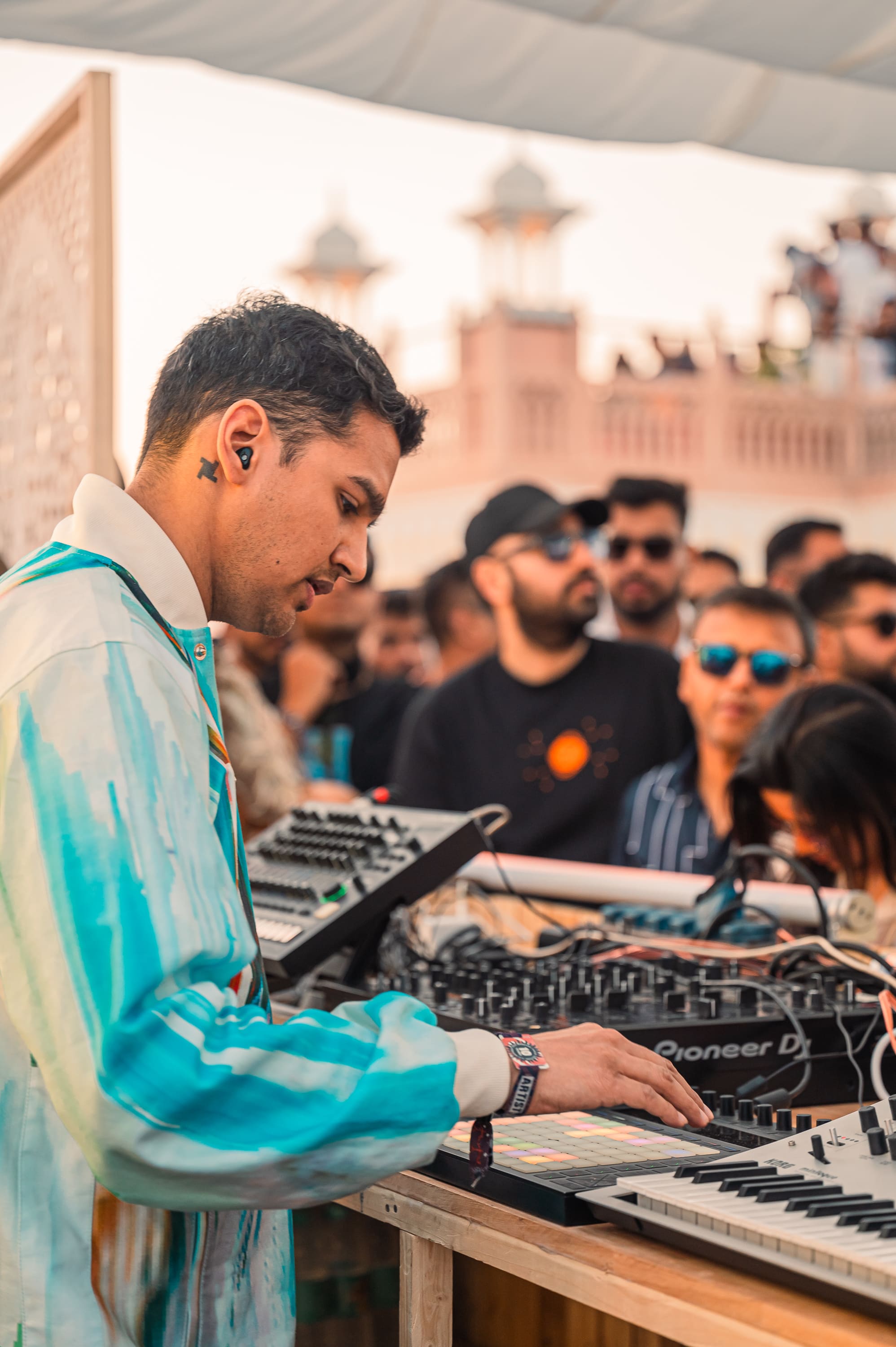
If we’re being completely honest, the soundcheck was nothing short of a nightmare. Our live setup usually involves around eight pieces of gear, and with only a ten minute changeover between acts, the programming team asked us to trim it down. We managed to bring it to six because any further and we’d have been compromising the essence of the set. That meant the soundcheck needed to be thorough, especially for setup and takedown, and the crew really stepped up to help us rehearse it. Where everything fell apart was the heat. The rooftop sat directly under the scorching afternoon sun, and the MacBook which holds the entire set, kept overheating. Panic naturally set in. The crew tried to calm us, reminding us that soundchecks on this stage are always tough for artists every year, and assured us that once the sun went down, the temperature would drop sharply. They were right. By showtime, the conditions had completely changed, and the performance ran exactly as it should have. Huge shoutout to the crew, when it mattered most, we managed a full setup and takedown in under four minutes, setting a new personal record.
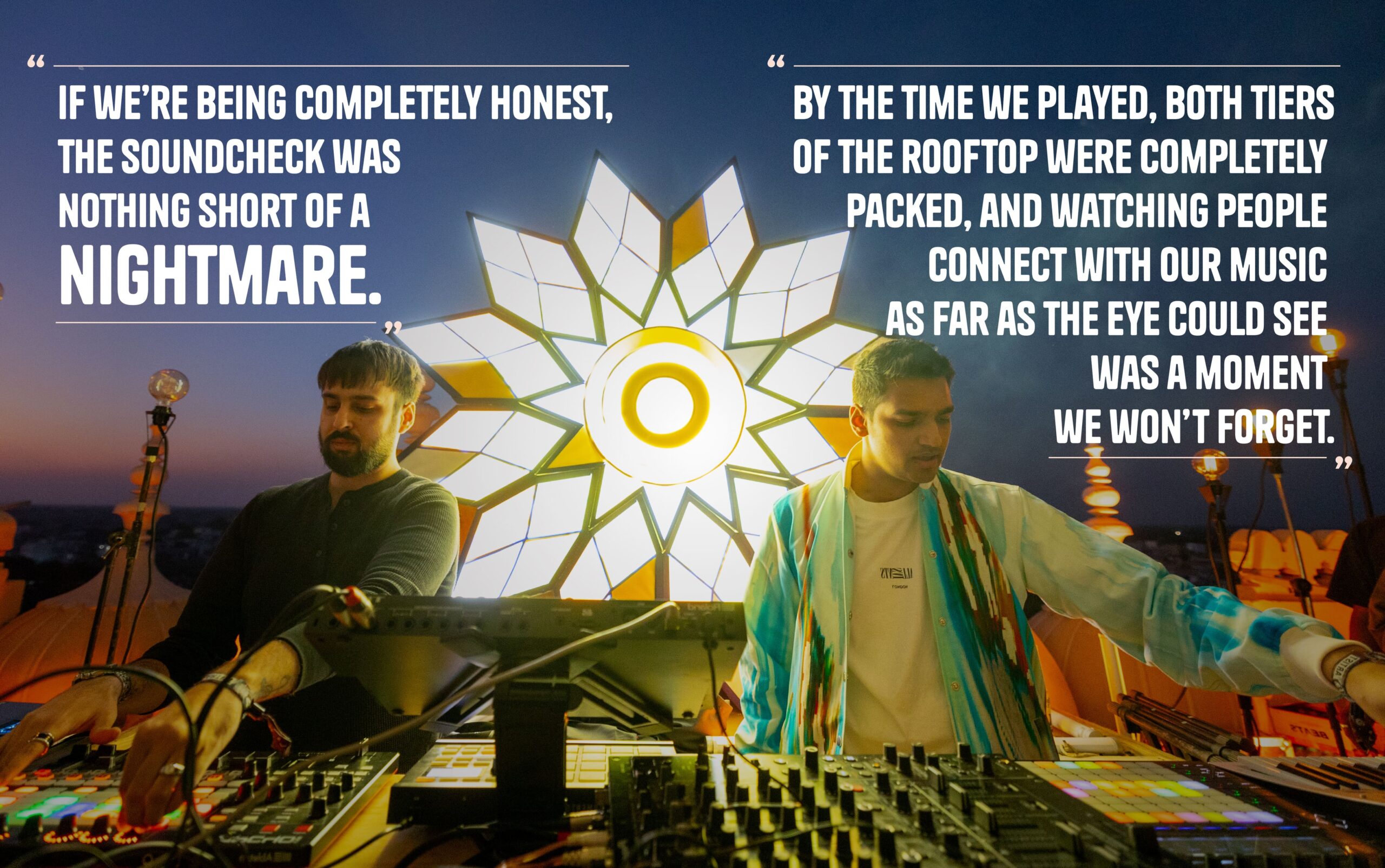
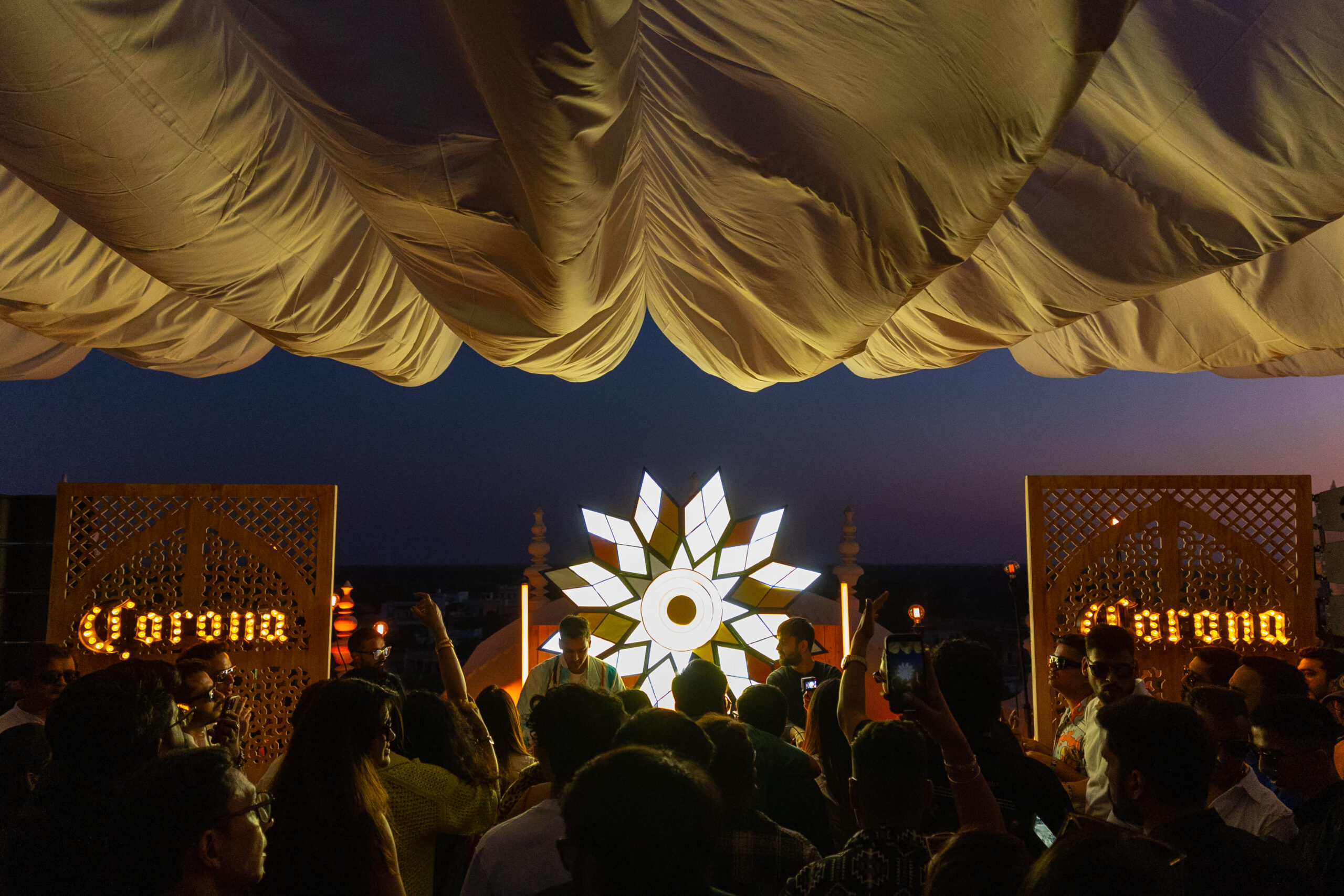
We stumbled upon a few vinyl sheets and some highlighter pens and, half-jokingly, made our own promo flyers. What started as a joke turned into a surprisingly effective way to pull people toward the stage. Eight of us, our entire entourage, walked around the desert holding simple flyers that read: “KillZen (Live) at Corona Sundowner Stage, 5:30 PM.” and before we knew it, the queue stretched from the base of the stairs all the way up to the rooftop. By the time we played, both tiers of the rooftop were completely packed, and watching people connect with our music as far as the eye could see was a moment we won’t forget.
I noticed how the tracks have been named quite uniquely with a storytelling premise. The ones that caught my attention from the album are “Born in the Shadows of a Distant Dream”, “Yesterday’s Contrition” and “Shrouded in Secrecy”. When you associated words and phrases to each track in this specific album, did you have a collective album storyline to talk about? Or would you like to leave the album’s interpretation to the listeners, depicting the story behind each track as they go?
Yes, the album titles were very intentionally chosen—they trace the emotional arc of our journey with the festival. Being invited in 2022 and then having to step away felt like a real heartbreak at the time. It was a huge opportunity, and losing it stayed with us. But things have a way of coming back around, and being invited again in 2024 made that story feel complete. That being said, we never force titles. The name naturally arrives, sometimes at the start of a project, sometimes halfway through, sometimes right at the end, but it always comes. With lyrical music, titles are relatively easier but with purely electronic tracks, the title has to reflect a feeling. What we’re trying to convey melodically is exactly what we hope the listener feels, in its most raw, unadulterated form.
If you listen to the album from start to finish and read the track titles along the way, the narrative becomes clearer—the near-miss, the disappointment, the doubt, and eventually, the full circle moment. Titles like Born in the Shadows of a Distant Dream came from a period when the dream felt like it was slipping further away, while Yesterday’s Contrition reflects the mixed emotions around 2022 where even though we played DGTL, there was still a sense of regret in missing Magnetic Fields. We’ve been gatekeeping our music, quietly performing some of these tracks for years without releasing them, holding onto the belief that they belonged at Magnetic Fields first. We don’t like leaving things too open ended or open to interpretation. As listeners ourselves, we want to feel what the artist intended. So with this record, the titles are there to guide you, to help you feel exactly what we felt while making the music.
Speaking of listener’s intent, in your interview with Tanishq Seth, Founder of the Fresh Lime Studios, you both talked about album formats and the intentionality behind. It really dawned on me that electronic music tends to have such an ardent grasp that listeners are rarely bothered with the length of the tracks, as opposed to pop music. Do you agree that a song’s length need not be a recurring concern to fit the contemporary concept of a “hit” song, even when it comes to electronic music?
Our process has never been about fitting into a genre or sounding a certain way because it’s “working” at the moment. For us, music is first an emotional outlet, it has to move us before it can move anyone else. If we’re not enjoying what we’re making, how can we expect anyone else to? We never start with questions like, How do we make this more commercial? or How do we make a hit? But rather, we put our faith in the emotion we’re trying to communicate and hope that it reaches the listener. If even one person understands what we’re saying without a single word being spoken, that already feels like success.
Over the past year, we’ve had people come up to us saying they’ve attended Magnetic Fields for 5-7 years, and that this was the most memorable set they’d experienced across all the stages. Others have told us they’d been waiting for this album for a year, some said they never thought they’d get to hear the full set again, and that now that it’s released, it’s become part of their daily listening ritual. These moments are incredibly validating and inspire us to keep doing more.
That said, it is disheartening to see how often music gets reduced to background noise in the age of short-form content and shrinking attention spans. I’ve spoken about this before with Tanishq and we believe that music asks for presence. At the very least, it deserves your full attention, because that’s what the artist gives when they create it.
What’s next for Killzen, and what is next for Anannya?
There’s no easy answer to what’s next for KillZen, but that’s kind of the point. We’ve been going deeper into different formats, immersive performances, spatial audio, and new live iterations and there’s still a lot we want to explore there. We’re also sitting on a huge amount of unreleased music, if you remember, close to seven albums’ worth. So we’re definitely not slowing down on releases anytime soon.
On a personal level, I want to grow as a multidisciplinary artist. I’d love to create and perform ambient music in dedicated listening spaces, explore orchestral writing and orchestral performances, while continuing to evolve our electronic live sets. One thing I’m especially excited about is finally debuting our ambisonic AV performance. The music and the concept are ready, it’s just a little ahead of its time here. The infrastructure, budgets, and general appetite for shows of that scale are still catching up in India. But when the moment comes, we’ll be ready.