Jay Panelia, In Conversation with Bharat Jain
(Edits & Design by Oshin)
If you’ve been around the Delhi music scene, you’ve probably felt Jay’s presence before you even knew his name. Starting out as Jay Pei, he spent years learning, absorbing, and building, until he reached a point where the music he was making no longer felt like his own. What followed wasn’t a rebrand. It was a reckoning. Today he makes music as PANELIA, and if you want to know who he is, he’ll tell you to just press play. Fragile, emotional, cinematic, and deeply personal, PANELIA is the sound of someone finally arriving at themselves. We sat down with him to talk about that journey, what home sounds like, and why his second album is called Screaming in Silence.
∼Oshin
Transformation
Bharat: I think this is the first time we are doing this formally. Most of our conversations about life and music happen very casually in between our jokes, but when I got the chance to share a small part of those conversations with our community, I took it without overthinking. Today’s conversation is about something many people are curious about, your journey from Jay Pei to Panelia. Now I’ve known you before the shift, before the name changed, when the sound slowed down and deepened. I’ve seen you move from Jay Pei to Panelia and it didn’t just feel like a rebrand. It felt like a shedding. A shedding of something. How do you know when something is no longer you?
Jay: I guess that’s the thing with this project that people have assumed that it’s a shedding, but I think this is the first time I’ve understood who I am as an artist.
The first project, Jay Pei… think of that as more of a learning phase of being an artist or being a musician or just learning to do things. The thing with learning is that your influences are part of the process. In this phase you don’t always end up being original. Most times it’s some inspiration through somebody else that ignites an idea of a piece of music or wanting to do something like somebody.
And it was good for me, but like I said, I reached a point where it didn’t really serve any purpose in my life. What I was doing initially didn’t really feel like myself and I stopped being connected to that music.
I wouldn’t say that the entire identity is gone. The good part of that identity is still there. The parts that were not my own and the parts that were borrowed are the ones that are gone. The ones where I learned about my music and what makes my music my own is what I’ve retained.

The emotional value of that music is what I felt is my own and it’s unfiltered. I don’t make music now that is serving a purpose for somebody else. The music now is purely personal. It’s purely for me and what I feel and what I want to say through music and nothing beyond that. And it’s through Panelia.
If anyone wants to know who I am, it’s in my new music. It’s fragile, it’s emotional, it’s not polished or cleaned. There’s imperfection in it, but it’s me.
Roots & Home
Bharat: That’s something interesting that you said, that if people want to know you, they can listen to Panelia. You describe Panelia as an amalgamation of your roots and your pursuit of self discovery. To me, it feels like a spiral, the sound of where you’re from and the sound of where you’re going, constantly circling each other. Do you feel rooted anywhere, or is movement part of your identity?
Jay: I don’t feel rooted anywhere and I don’t think I’ve settled either. I don’t feel that I’m constantly chasing a settlement. The fact that right now I’m in Delhi and I’ve been here for the past 12–13 years, a lot of myself, who I was when I was back home in Rajkot, is left there. It’s not really here at this moment and in my music either.
This music starts from the day when my journey from Rajkot started. It really isn’t about when I was back home, who I was and what I used to do, but the day I left my hometown is when this journey started with music. Most times when I write music, it’s about when I left home and not what it used to be. So I don’t think it’s rooted there or here. I’m still in the process of learning who I am as a person and who I am as a musician.
Through the pieces of music eventually I hope that I find that, but at this point it’s still in the discovery phase. The music that I make now is still beginning to find its shape and I think maybe in 10–15 years more I will understand what it is. I want to give this all the time that it takes. I’m in no rush to understand or declare that this is who I am.
Bharat: You moved from Rajkot, your roots, and then you made Delhi your home, and you’ve been here ever since. Is there a sound that feels like home to you?
Jay: Yeah, I wouldn’t say a sound, but melancholy is where I feel at home.
The music that I write somehow always speaks about the negative side of emotions. The most positive that you will ever hear in my music is the feeling of hope. Never triumph or celebration or the joyous part of life.
It’s always about the struggles of life. It’s always about the things that you don’t want to tell people. It’s about being quiet in a very loud environment. It’s about feeling alone between people. It’s about not feeling confident or not feeling that you understand your purpose.
I could be in between ten people enjoying a moment, but deep down there are always existential questions. That’s why the music is more fragile. When I say fragile, it’s emotional. The tones are distorted, grungy. Sometimes it feels like someone is screaming.
That’s why the second album is called Screaming in Silence. When you hear the music, it feels grand, but not in a celebratory way. It’s like somebody is screaming. It’s grand in that way.
Storytelling & Cinema
Bharat: Yeah, I think it’s always about telling different stories through your music through different sonic elements and tones. Nothing and All at Once feels less like a collection of tracks and more like a set of environments. Almost like you’re building spaces rather than songs. Through those lush synth pads and textures, it feels cinematic. Were you thinking in terms of emotional arcs the way a writer or filmmaker might while composing?
Jay: This album was written thinking about specific incidents in life.
Each song has a meaning. For example, ‘As I Walk Towards You’ is about a time when all my life before getting on stage, my effort was always to reach the stage. I used to help my friends set up their gear, their drum kits. I was there on stage, but not as a performer.
So it’s about that closeness to the stage, but not being there. That’s why it’s called ‘As I Walk Towards You’, where the “you” is the stage.
‘A Distant Dream’ is about when you see your favourite musicians perform something unreal, something that leaves you with a feeling of ‘what did I just experience’. So that song is about wanting to create that feeling for someone else. That’s why the production is big, the snares are big, the synths are big, it’s meant to feel like that distant dream.

‘Obey The Machine’ came from when I started performing and everyone tells you what you need to do, how to perform, how to make music, what you should be doing to be successful. There’s always this idea of what you should become, and people start putting you into a box. That’s why it sounds very robotic, very mechanical.
‘I Stood Still While The Whole World Danced’ is about a phase where life felt very monotonous. I was working, I was learning, but it felt like everything was moving in one direction while people around me were just enjoying their lives, not worrying too much. I didn’t feel like I was part of that. And also, when I perform, I don’t really move. I get very locked in and just stand there, almost staring, trying to understand what I’m feeling or why I’m connecting to something. So it’s both a metaphor and something literal.
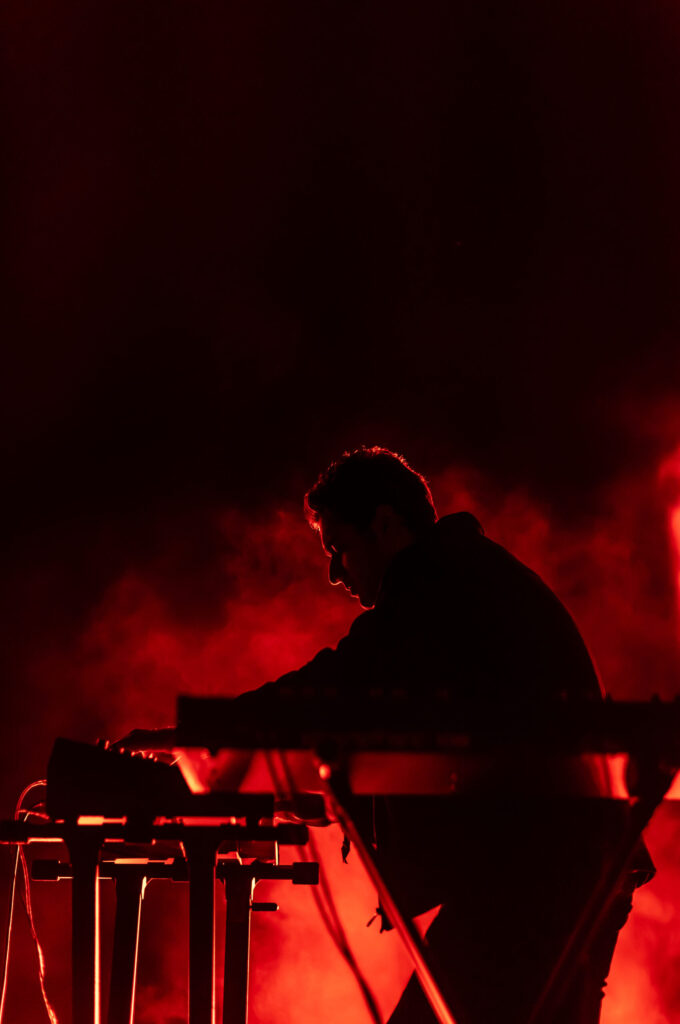
‘Far Away From Home’ was the first time I got to play internationally. After 12 years of dreaming about it, it happened. I remember that moment very clearly. In the beginning there was barely anyone there, and by the end the stage was full. It wasn’t about how big it was, it was just the fact that someone far away believed in the music enough to invite me. That feeling was emotional, and that melody is exactly that feeling.
There’s a song called ‘Voice of Reason’, which is that part of you that always finds logic, the part that stops you from bursting out. It’s an ironic name for something that sounds so heavily distorted, grungy, and fast, but that’s exactly what it is. It’s like a voice that holds you back from fully unleashing yourself in a civilised society, because even though you feel like doing it, you can’t. I’ve always been someone who appears calm and composed, but that’s just the exterior. That’s not what’s happening inside. Being calm is almost like an exercise, because no one really is. Inside, there’s a volcano bursting out for everyone.

Influences
Bharat: This is the first time I’m actually hearing about the stories behind the tracks, and now everything makes so much sense. The whole album suddenly feels even more so connected. One point I also want to bring back is what you spoke about earlier, about influences.
For me, finding a voice in music has always felt like shaping something from the subconscious echoes of what we’ve absorbed over the years. I also feel authenticity doesn’t come from escaping influence, but from refining it. When you listen to your recent album, can you trace the influences that shaped it, or have they dissolved into your instincts?
Jay: I think the influences are still there, but they’re not direct anymore. Earlier it would be hearing something and wanting to do something like that, but now it’s more about being inspired by people who allow themselves to be who they are. That’s what inspires me now.
When I make something and I feel like it’s sounding like somebody else, I stop and rethink. Because I don’t want to continue in that direction.
I don’t think anything is truly original. We’ve all grown up consuming things, so everything comes from somewhere. But if you’re aware of it, you can use it in your own way. Instinct for me is just being confident in the decisions that you’re making. You can’t escape influences, but you can be aware of them and make choices that shape them into something that feels like you. And I think that’s where maturity comes in.
Bharat: Thank you so much for this conversation. It is always very inspiring speaking about life and music with you. Thank you so much and all the best for your second album. When are we getting to hear your second album?
Jay: When the time is right, I guess. I’m in the process of figuring out how and when to release it. I’ll put it out soon.
Bharat: Amazing. Thank you so much, buddy. Signing out.
Jay is still in the process, still discovering, and completely okay with that. In an industry that constantly demands definition, there’s something quietly radical about an artist who refuses to rush his own becoming. Keep an eye on Panelia, because if this conversation is anything to go by, the best is very much still on its way. Follow his journey on Instagram at @jay_panelia and when Screaming in Silence drops, you’ll want to be ready for it.
∼ Oshin

(Left: Bharat Jain, Right: Jay Panelia)