Oshin Hephzibah /
Can You Hold On? A Conversation with Pritpal Singh aka Sudan
Read More
Oshin Hephzibah /
Becoming Zoya: India, America & Pop’s New Voice
It’s midday in Sydney when Zoya Mohan appears on my screen, greeting me with a welcoming smile. On a Sunday evening, the sunlight pours in from the window behind her, she joins me from her brother’s house, having generously carved out time on a rare day off for our interview. Zoya is warm and personable, sitting cross-legged on a divan in a furry leopard print jacket, ready to talk about her evolution as an artist and her upcoming album, ‘The Human Era is Over (The I/O)’. Our conversation, scheduled for an hour, spills into two, as she impassionedly and articulately answers my many questions. A skilled conversationalist, she tells me I am “catching her at a very interesting time”, after returning from her first trip back to India since moving to Los Angeles, to now gearing up for the release of the first single from ‘The I/O’, only a month away.
‘The Human Era Is Over’
India-born and California-based Zoya Mohan is a pop artist and singer-songwriter. 2025 has been a momentous year for her. Since April of this year, Zoya has been keeping fans intrigued and engaged by gradually bringing them into the world she has built in her upcoming record, ‘The Human Era Is Over (The I/O)’. Releasing one song at a time, every three weeks, Zoya’s Instagram has become populated with striking, eye-catching visuals. In one reel, she is standing on the side of a promenade holding up a sign that reads, “If everyone is an artist, does anyone know what art is?”. In another video, she is expressing her skepticism of online dating and her affirmation for real-world connections and happenstance. Rejecting algorithm driven romance where soulmates are supposedly ‘a swipe away’, she playfully pours these sentiments into “Love On a Machine”.
“We are all connected. But are we connecting? If everyone is an artist, is there any value to being an artist anymore? When Tik Tokkers are becoming popstars, is there any value to saying something? Does what I have to say even matter anymore in a world where we have millions of voices saying something at the same time, all the time, every second of the day?”
These pressing questions and concerns about the existential nature of what technology is doing to love and art were brewing inside her for almost two years – a period of silence, before she wove them into the record, ‘The I/O’. “‘The I/O’ is definitely my extension of the thought that if we lose love and art, that to me is the end of humanity. ‘The Human Era is Over’ is the question. And if it is, what are we going to do?”
What is the Human Era is Over (video link)
The record includes the recently released ‘Twenty-Nine’ – a stripped back contemplation that voices some of the fears that contributed to the two year period of silence in the lines,
“What if this is all over when I’m thirty
What if this is the end of the whole ride
And everything was experience that I never needed
Cause the right things never happened at the right time?”
In grappling with the lingering fears and doubts that plagued her, she came to understand, “Somehow you choose to either pick up the tools, take self-responsibility of your life, figure out what makes you happy without any external world and figure, and figure out what your relationship is with your internal one. Once you do that, you’re looking at the external world from a different space completely.”
To write this record, Zoya took a leap of faith. Without any label backing, she proceeded to create it compelled solely by the power of the ideas stirring inside her. “I knew I needed to get these ideas out of my system because that’s naturally what I’ve always done and these thoughts were starting to get suffocating.”
Creating the Album
Gathering in a house in Palm Springs, California, she collaborated with her dearest friends – Aida Frantzen, Arya Gaston, Austin Sexton, David Bone and Nick Smith – and wrote ‘The I/O’ in just five days. It was then that she realised that the previous two years of silence were actually an incubation period of collecting the pieces of the puzzle that would go on to become, ‘The I/O’. “I didn’t even know that over those two years I was collecting elements of what this was! I had no idea!” she exclaims. “The album title, for example, ‘The Human Era is Over’ – that was capitalised on a blank page in my journal for a year and a half!” Being at Palm Springs in the highly-charged, intensive environment for five days, was the breeding ground for creative sparks. Working with multiple producers stationed in different rooms, she hit the ground running.
Zoya was deliberate about “creating something intentionally” but describes the entire five days as an “accident” where they got out “out of their own way” and “got things down”. She attributes the end result entirely to “happy accidents” and “little moments of creativity”. “I didn’t even know actually after we were done. It just happened! It was really amazing to be with all the songwriters and producers I was with to write this one because they helped me figure it all out for myself,” she says.
Coming of Age
After listening to “The I/O”, her inner circle is echoing the feedback that this is the “most Zoya” her work has ever been. Arriving at this point of honesty and authenticity mirrored in her artistry comes on the heels of a decade of trials, tribulations, and journeying back and forth from Boston, to Mumbai and then onto Los Angeles. Having spent four years in Mumbai after her time at the Berklee College of Music, Zoya built a thriving career in India that saw her grace the pages of leading magazines like Harper’s Bazaar, Vogue India, and Rolling Stone India, and perform at some of India’s largest festivals like NH7 Weekender. Reflecting on her time in the country, she says, “Away from solidifying a sense of self, India teaches everybody something. I really learned how to flow in the chaos and that was the biggest lesson I’ve learned in life. That has helped me figure out a lot of things that have happened ever since.” Her return to India after years away is confirmed at the time of writing, with her impending performance at Lollapalooza, Mumbai being announced for late January, 2026. She highlights the significance of the performance over an email, saying, “This is more than a show for me – it’s a homecoming. Coming back to Mumbai after seven years and stepping onto the Lollapalooza stage with the pop show I’ve been building towards all these years feels like the moment I’ve been waiting for.”
Everything Was Beautiful and Nothing Hurt (visualiser)
Growing up Indian in California, questions of identity and cultural hybridity were woven into Zoya’s life from early on – reflected in her evolving sound over the years. Behind each album, each sonic shift, and each sojourn was a girl searching for her place in the world. In Berklee, she did so by leaning into what made her unique – her Indianness. It was when she arrived in India, that she realised that the tables had turned and she was now the American girl. This was a turning point because she realised her true passion and true self lied in the sounds of pop music, prompting her return to California. “This was what I wanted even as a kid, being six-years old on my parents staircase belting out Britney Spears. That’s where this originally started so it was like a full circle thing,” she recalls fondly.
But for years, her dreams hit a glass ceiling due to the lack of South Asian representation in pop culture. “Growing up in Orange County, I never thought a girl who looked like me could be anything in pop culture let alone be a popstar because there were no examples of that.” A judicious risk-taker, she gathered her will and aimed it in a new direction with this realisation by deciding to fight for South Asian representation in pop culture. “In the end, it turned out that the thing I thought I couldn’t do became the thing that I am fighting for because I want us Indian girls to have versions of us out there in pop culture in all types of fields. It took me growing up as the Indian girl in America and the American girl in India to really lean in who I am.”
In a world designed to neatly categorise us into pre-existing black and white boxes, Zoya decided to dance in the wilderness by creating her own box and choosing the path of authenticity. Walking the road less trodden came with its own set of hurdles. “The choice to chase after something like this comes with a lot of politics. There have been so many Indian executives in India to white executives in America telling me I need to be ‘more Indian’ to market to Indians. I felt really boxed in by the stereotype and didn’t want to use it as a gimmick,” she recalls. Without using “the culture card” to propel her forward, her playing field widened and her job became infinitely harder because she had to compete globally with her art. It is almost as if she needed to play the game in the same way as her white counterparts to prove her mettle and make her mark as an Indian girl. To hone her craft and prepare to play on the global stage, Zoya was developed by the team of producers from ‘A Star is Born’ including Mark Nilan Jr.
The Songwriting Learning Curve
Working with Mark and his team was a rigorous yet rewarding process. Being pushed to her limits during this time, one of her key takeaways was the fine skill of rewriting a song. “Mark really understood and sat me down in the same place where Gaga wrote ‘Born this Way’ and said she was rewriting ‘Born this Way’ for four years to make it perfect. He said that what you’re trying to say can be said simpler, or this is too complicated, or that’s not conversational enough… And I would get frustrated and it was really intense.” Through the process of writing ‘Bad Girls Dream’, she learned to walk the tightrope of pop songwriting and rewriting. “It’s a muscle in my head now. I’m rewriting while we’re writing. I’m already simplifying, fixing, moving, and doing things to be effective and make it stronger on the first listen,” she explains.
Zoya likens her experience of songwriting, in this period, to a sport, where she had the impeccable ability to walk into a session with unknown producers, create an imaginary situation, and write a song around it. This process sharpened her craft and brought her closer to her artistic voice with the realisation that in her own body of work, she wanted to be led by the message she wanted to impart. “I think it all depends on what kind of artist you want to be. I grew up in a world where I looked up to songwriters who said something and that touched me. I want to be that kind of songwriter.”
When writing “The I/O”, the question “what am I saying?” took central stage and became her compass through the formidable undertaking of creating a record. In 2025, the creation of the record, she tells me, is only half of the job in the life of an independent pop artist. The “marathon sprint”, as she calls it, is the marketing, distribution and release process which involves “building a world and figuring out how you want to get this message across.” For her, embarking on this latter half of the journey means being hands-on with every part of the process – from editing her own photos for the very first time, to styling. Her involvement has grown as she has grown into a woman who believes that she is, in fact, good enough, and can trust her own self– less swayed by the noise surrounding her and tuned in to instinct. “I’m at this really interesting point of trusting my own taste. I believe in my own taste.”
Reflections
Questioned about what advice she would impart to her younger self knowing what she knows today, she is unsure about whether or not she would tell her anything at all. A believer in things unfolding the way they are supposed to, she says, “I just want to let her live and figure it out because all of those things gave me the backbone I have now to live off of these curtains in the wind.” On second thought, she adds, “What I will say is I wish I valued myself, my body, my time, and my energy, more, earlier. I would tell her to not go through phases of devaluing that. That has been such a big shift in my experiences as an artist but also, in my experiences as a woman in the world.”
Free (visualiser)
Carrying these reflections into the creation of “The I/O”, she concludes, “I think that the biggest thing in the last three years has been that I’m very aware of the waves of life now. Everything in life has been big waves and then the float – it’s about learning to ride the wave and enjoy it, while remembering that still water is always just around the corner. So I just try to be present. Everyday I am pulling the thread and trying to be mindful of what’s happening in front of me right now. And little by little, this whole thing, “The I/O” gets built!”
Read More
Oshin Hephzibah /
Zahara at GMI: A Retrospective
Read More
Oshin Hephzibah /
Making the Art Industry in India Accessible, Inclusive and Less Intimidating
Making the Art Industry in India Accessible, Inclusive and Less Intimidating:
A Conversation with Meher Sachdeva
Written by Aanchal Bordoloi
In a world that is presenting us with more opportunities to dabble with the arts and live out our rockstar dreams, anArtizen stands out in the Indie music space. A brainchild of Meher Sachdeva, who is often seen in the scene, associated with helping creatives or artizens in reaching their potential, anArtizen aims to make the journey a little less intimidating. I got an opportunity to get in touch with Meher, and here is how our conversation unfolded:
To begin with, could you please tell us a little bit about your work, and the vision with which you approach artist management?
My work sits at the intersection of artist development, strategy, and cultural programming. I’ve always been driven by a desire to build frameworks that allow artists to be both creatively free and structurally supported.
At the heart of it, I see artist management as a partnership—one that’s rooted in trust, clarity, and shared vision. A big part of my process is goal mapping: understanding where an artist wants to go creatively, professionally, and personally, and then working together to chart a path that’s both ambitious and sustainable. It’s not about chasing trends or quick wins—it’s about building something that lasts. Sustainability, for me, means setting up systems and timelines that allow artists to grow at a healthy pace, without burning out or compromising their values.
What qualities in an artist/band do you look for before signing them at your respective artist management companies?
I look for a sense of identity, an openness to evolve, and a willingness to treat the journey as a partnership. Management isn’t just about services—it’s about co-building a vision, together. So I pay attention to artists who are self-aware, willing to put in the work, and curious about growth. The numbers can always be built over time—what’s more important is the artist’s commitment to their craft and the kind of relationship we can develop. This isn’t a one-way street; it only works when there’s mutual trust and alignment.
Looking at current musicians in the Indie scene who have become very accomplished and successful in terms of performing their music and reaching large audiences, I’m sure it would have taken years of hard-work for these brilliant artists to finally get the spotlight.
With the rise of an ever-growing interest in the Independent music industry such as the growing number of artist management companies and music conferences, do you think that maybe we could speed up this process of getting better at identifying potential in artists and contributing to their growth in the early stages?
Yes, I do think we’re at a point where that process can be accelerated—but only if we evolve both our tools and our mindset. On a technical level, we now have access to more real-time data than ever before. Early signals like audience retention on short-form content, playlist performance across platforms, live engagement metrics, or even growth in niche online communities can all help us identify potential far earlier than we could a few years ago. But the challenge is interpreting that data with nuance—not just chasing numbers, but understanding patterns and context.
On the A&R front, the more we invest in structured discovery—through curated showcases, residency programs or digital-first scouting strategies—the better we get at spotting talent early. Ultimately, we can absolutely move faster—but we also need to move smarter. That means combining data with instinct, and ambition with infrastructure that’s built to support long-term careers, not just viral moments.
International acts such as Coldplay, Dua Lipa and Ed Sheeran have now begun to add India to their world tours. What implications would this have for the Indie scene in our country?
It’s an exciting time. International tours in India are definitely expanding the landscape for live music and setting a new benchmark for production, fan engagement, and experience design. But the real opportunity lies in how we integrate our own indie talent into this wave—opening for global acts, programming local festivals with the same energy, and investing in homegrown infrastructure. It can be a catalyst, but only if we ensure the momentum benefits our local ecosystem too.
When you are looking at signing artists, do the numbers really matter? – as in the number of Spotify listeners, Instagram followers? What does an artist need to do/work on to show their promise and potential in delivering good performances and honing their craft?
Numbers don’t paint the full picture. They can indicate momentum, but they aren’t a substitute for intention, effort, or artistic ability. I’m more interested in the long game—what are you building, and how do you show up for it every day? A strong partnership is what lays the foundation for everything else. Followers and listeners can grow with time and strategy, but things like work ethic, clarity of thought, and the ability to collaborate meaningfully—that’s what makes the difference. Artists don’t need to have it all figured out, but they need to be committed to the process.
Would you have any advice for aspiring singer-songwriters looking at getting signed?
Start by getting clear on why you’re doing this. Build a body of work, no matter how raw. Collaborate, perform, release music, get feedback, and stay in the loop with the community. Managers are always looking for artists who are already in motion—so the best thing you can do is start walking your path, and eventually the right people will join you on it.
How important are regional languages in music? We are aware that the film industry seeps into almost every aspect of our lives, from a socio-cultural perspective. As is the case in the state of Karnataka, a large portion of the Indian population is still yet to expand their listenership to songs written in the English language.
Regional languages are not just important—they’re essential to the future of India’s independent music scene. We’re seeing a real shift in how listeners engage with language in music. Tracks like ‘Tamdi Chamdi‘ have proven that regional languages can cut across geography, class, and culture when the music is rooted, honest, and sonically compelling.
https://youtube.com/watch?v=kmjeMrjOjFA%3Fsi%3DYtfAvwvyhY4azpgK
These songs aren’t just doing well within their linguistic communities—they’re crossing over, being used in reels, live sets, playlists, and even brand campaigns. That’s a powerful signal. The idea that English or Hindi is more “universal” is slowly being dismantled as audiences open up to music that feels culturally specific but emotionally universal.
How do we work on making the Independent music industry more inclusive and accommodating of newer and fresher talent? For example, adding newer names to festival line-ups.
Inclusion starts with intention—but it doesn’t end there. While programmers, curators, and festival organizers do need to be more deliberate about bringing in new voices, it’s equally important to build audiences that are open and curious. Cultural education plays a huge role here. If we want diverse artists to thrive, we need to foster listening cultures that value experimentation, different languages, and alternative narratives—not just what’s familiar or trending.
It is nice to see so many more women taking up crucial roles in the music business. We would love to hear a bit about your personal journey as artist managers in this industry and if there were any roadblocks you faced that felt unique to you.
I’ve definitely been in rooms where people wouldn’t address me directly, or would assume I wasn’t the decision-maker—and of course, that’s tough. I think specifically in music, it’s also tough to work the hours we do in India in the nightlife world, and sometimes, that can also be intimidating.
But over time, I’ve learned that part of the work is in making conscious choices: choosing to stay in those rooms even when it’s uncomfortable, choosing to trust your voice, and choosing to find the right people who see and value what you bring to the table.
It’s not always easy, and it does take a toll sometimes. But you also learn how to back yourself, and how to navigate the industry in a way that’s honest to you. That clarity becomes your strength.
And thankfully, things are shifting. More women are entering this space with confidence, collaboration, and fresh perspectives—and that gives me a lot of hope for the future of the industry.
Read More
Oshin Hephzibah /
Small Town, Big Love, Little Homes: In Conversation with When Chai Met Toast
Read More
Oshin Hephzibah /
Students Speak: Lavanya Dube
Compiled by Sohaib Durrani
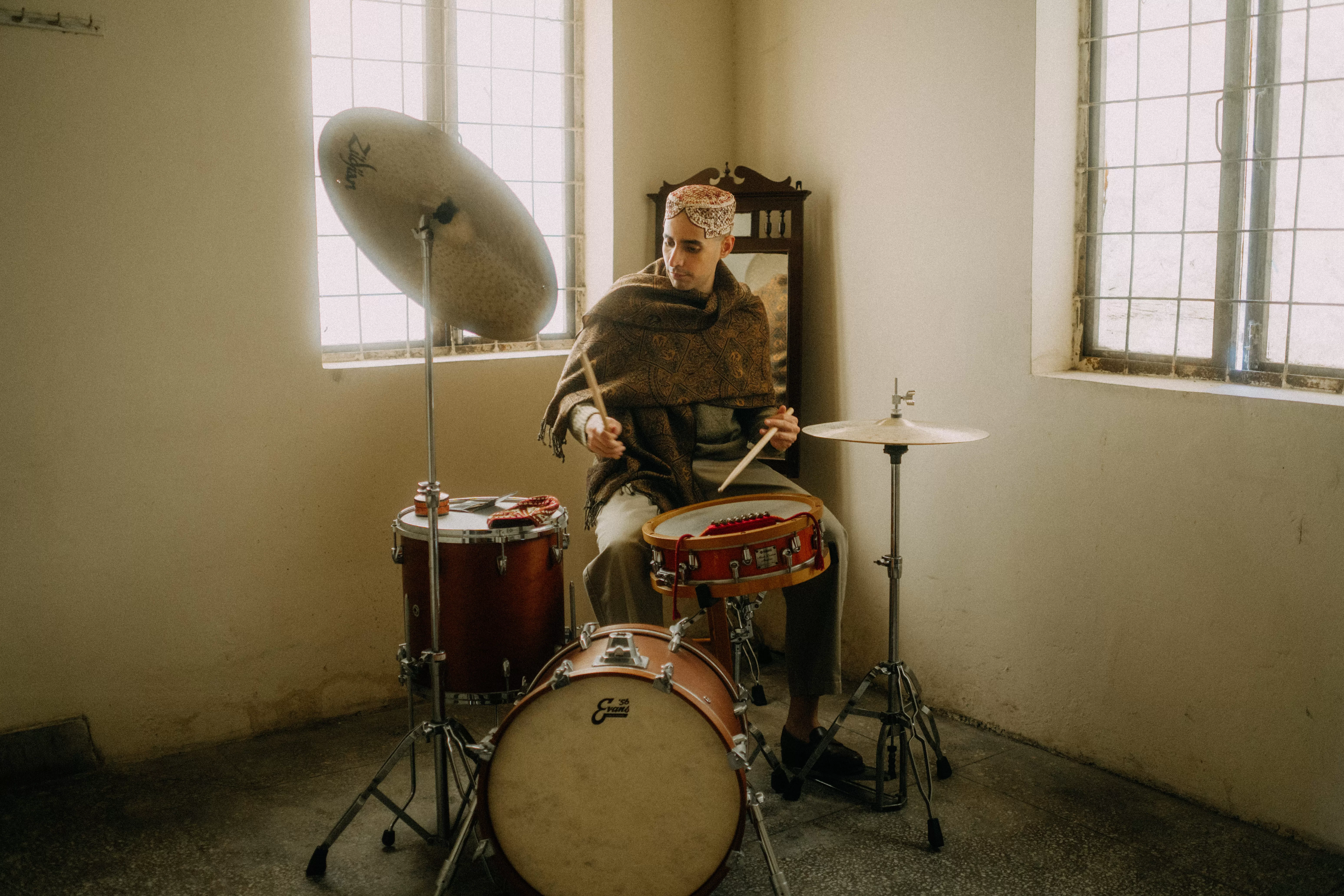
Lavanya is a versatile and dynamic musician known for his powerful performances across blues, R&B, and rock. Based in India, he has consistently captivated audiences with his expressive drumming and deep musicality.
His notable appearances include performing at the prestigious Ponniyin Selvan: I audio launch and with the KMMC Blues Ensemble, where he showcased his rhythmic command and creative flair. In 2024, Lavanya delivered a standout rendition of the AS-BAQUETAS snare piece, earning praise for his technical precision and stage presence. His reinterpretations of iconic tracks like “Little Wing” and “Cissy Strut” reflect a perfect balance between tradition and individuality.
In addition to live performance, Lavanya has explored the world of music technology, studying audio engineering under Vasudev, founder of Mix With Vasudev Studios in Delhi. This experience has equipped him to support artists in mixing and mastering music for digital platforms.
He is currently pursuing his education at Global Music Institute in Greater Noida with us, where he continues to refine his craft and grow as a contemporary musician.
Below are the excerpts from a conversation exploring his musical beginnings and inspirations. Read on to learn more about Lavanya.
What instruments do you play, if any?
Guitars and Drums
When did you become interested in music?
Back in 2017 when my school music teacher started his own music academy. I joined it as hobby and after that I felt that if there is anything I can do, its music.
What drew you to study at GMI?
The fact that it is one of the only institutions that offers contemporary music performance which follows the curriculum of Berklee.
A memorable experience at GMI:
For me it’s my Private Instruction and my lecturers with Lucas Sir, as he didn’t only teach me how to play drums or teach me theory, he actually taught me how to apply those in real life scenarios.
A fun fact about yourself:
I don’t know if it’s fun or it’s a problem but I figured out that I only function with focus when I am under pressure.
Your favourite food:
Rajma Chawal
If you weren’t a musician, what would you be?
A Psychologist
An artist that currently inspires you:
Steve Jordan
A track that currently inspires you:
Neon by John Mayer
Your musical idol:
John Mayer
Your dream collaboration:
Managing or working with Sahil Samuel
How do you spend your free time?
I like going out and exploring new places, cafes and hangout with friends.
A quote that keeps you going / inspires you:
Good things takes time.
An instrument you wish you could play / want to learn:
Double Bass
What is your favourite music course at GMI, and why?
Music Business, as it’s really important to learn about how the industry works and honestly, few places actually teach about it and GMI not only teaches practical and technical aspects of music business but it actually prepares you to step out in real world.
What are your career plans or ambitions after graduating from GMI?
I want to be an artist manager, drummer and audio engineer.
What is your favourite thing about the GMI campus or community?
That the GMI community doesn’t end once your course is over, it’s a life time connection with people with so much knowledge and skills which stays with you once you are done with your courses.
What genres of music do you listen to most?
Blues, Jazz, Bollywood
Who are your favorite musicians or bands?
John Mayer, Anson Seabra, Guns and Roses
How would you describe your personal music style?
Experimental
Read More
Oshin Hephzibah /
From Big Bad Wolf to Level House: In Conversation with Yama Seth
From Big Bad Wolf to Level House:
In Conversation with Yama Seth, a Leading Force Behind the Indie Music Scene
Written by Aanchal Bordoloi
Edited by Sohaib Durrani
One word to describe my conversation with Yama: Goosebumps. This interview felt like a Godsend — a conversation between a stellar artist manager and an aspiring singer-songwriter. Through this interview, I got an opportunity to have a glimpse of the behind-the-scenes moments of some spectacular shows in the Indie scene. Yama has spoken in-depth regarding how she had initially started out, and her experiences and thoughts around the ever-evolving music scene in the country:
To begin with, could you please tell us a little bit about your work, and the vision with which you approach artist management?
I am Yama, and I started out working at Big Bad Wolf which is a Delhi-based agency that represented quite a few artists and bands. This was 10 years ago. I started with curating venues first at Big Bad Wolf and subsequently got into management which was for Vir Das’s Alien Chutney, which was Das’s comedy ensemble. I started touring with them and then got into 360 degree management with Parvaaz, which is a Bangalore-based band that I’ve been representing for quite a while now. Several more artists got added later, including Indian Ocean which has been active and releasing music for 35 years now and I represented them for 7 of those years which has been an important feather in the hat for me. I then moved out of Big Bad Wolf and started my own vertical, by the name of Level House. A couple of artists who were with me at Big Bad Wolf moved with me – Parvaaz, Parekh and Singh, Sameer Rahat, and some newer folks like Raman Negi and JBabe who’s the frontman of the F16s.
We’re just shy of completing 2 years with Level House and it’s a company that is under the umbrella of Skillbox. The parent company, Skillbox, is a ticketing platform, and Level House is sort of the management vertical of it. Apart from management per se, I’ve also curated a few festivals in the country including Ridermania which is a Royal Enfield IP that happens every year in Goa. Primarily, my focus for quite a while now has been artist management.
In terms of approaching artist management, it’s a very specific and niche roster that I have, and the reason I have these people is that I have never represented any artist whose music has not moved me individually, and this plays a huge part in being able to add on to their trajectory when you really love what they do. I don’t need Third Party motivation in my life to be able to keep me going because I really appreciate the music and I really want to keep working towards it everyday. The other thing that seems to be the theme, now that I have been doing this for 10 years, that kind of stands out, and is that the reason I call my agency LEVEL HOUSE is that I want to create a level-playing field. I have seen that in quite a few agencies in the world that whenever there is an A-lister, all the attention is focussed there and for us we did not want to focus all our resources towards any one particular artist and I wanted to make it a level playing field where all the artists receive the same kind of attention and ensure in-depth detail and strategizing. We want to build this kind of ecosystem within our agency and this also goes for our tour managers on the staff-end of things. All of the people that work at Level House don’t only think about the growth trajectory of one particular artist. It’s a collective effort. This has been a central theme in how I look at artist management. It’s also about the younger new-comers with the same intention that you would look at anybody else. This is largely the ethos of it.
I appreciate this! It is beautiful to note that at Level House, an equal amount of importance is placed on the growth of every single artist on board – instead of only focusing on artists who are well-established in the scene.
What qualities in an artist/band do you look for before signing them at your respective artist management companies?
I find this question a little obnoxious. Between you and me, you’re the artist right? I don’t know how to play a song/play the guitar/sing or anything that comprises this beautiful thing we call music. So how is it and in what kind of parallel universe, do I as a manager get to pick and choose the artists I work with? In the hierarchy of things, no matter which stage the artist is in, I feel the artist has the upper hand and more often than not, in my case, it’s always the artists who have approached me.
I am not a label that does A&R . I work in management which is basically a version of enhancing the artist’s pre-existing vision. So, I don’t go around looking for qualifications in an artist, because honestly, I don’t think I have the authority to. It’s lucky that the work I have put out with different artists has been visible and that artists have reached out to me themselves. I have somebody as seasoned as Backstratblues on my roster and there is no way I can tell you what quality it is that I look for in Backstratblues. So there is no sort of parameter that I measure them with.
The one thing that I do really care about in any artist is that they have to have some kind of an urgency and focus towards what they do. To break it down with an example, I don’t think I work well with artists who have their hands in 50 million pies…you know…and music is one of the pies. I’ve always worked best when my intention is met with the artist’s, who is very focused about doing just this thing. I really need the artist to have a clear vision that – this is my priority. This helps to really pave the path for me to work in the best form possible. Instead of a qualification, it’s more of a mindset thing that we share with the artist.
Thank you for saying this. It is good to know that it is essential for artists to have a clear vision and a sense of focus and urgency towards their artistic pursuits. I feel that this is important in a time where the number of Instagram followers and Spotify listeners seem to matter more than artistic integrity and music quality.
Thankfully I have been able to stay away from “influencer music”, for the lack of a better word. Hopefully I can stick it out without it. What I see is that a lot of these people who have millions of followers don’t have the same ticket-selling capacity. I say this with great pride that nobody in my roster has that issue. You have come to my shows and seen the crowds…
Yes! (I have attended shows of Parvaaz and Parekh and Singh in Fandom, Bangalore and in fact opened for Parvaaz too)
I want to stick in this phase and see how long I can go on with being a purist in music, I guess.
That’s really beautiful!
I understand that factors such as how many tickets an artist is able to sell and whether they would be able to fill venues with a good audience is essential, artistic integrity should not be lost sight of. I agree with you; I have attended shows of both Parvaaz and Parekh & Singh. They always manage to get a very good crowd and the venues have always been jam-packed with fans.
Looking at current musicians in the Indie scene who have become very accomplished and successful in terms of being able to perform their music and reaching large audiences, I’m sure it would have taken years of hard-work for these brilliant artists to finally get the spotlight. With the rise of an ever-growing interest in the Independent music industry such as the growing number of artist management companies and music conferences, do you think that maybe we could speed up this process of getting better at identifying potential in artists and contributing to their growth in the early stages?
Okay, so this is sort of a meandering point of view but let me tell you something.. 5-6 years ago, pre-Covid, there wasn’t this kind of organisation in the music industry. What I really do appreciate, is that now there are these conferences where you get access to publishers…where you can access labels as young artists as well as performing rights societies, copyrights societies, brands, live event curators, festival curators, ticketing partners… Musicians can now get access to them and understand this world in depth a little more, but I don’t think that this directly translates to an artist blowing up quicker. I have these kinds of conversations with people I represent on a daily basis. The reason it has taken maybe 6-7 years for Bloodywood to get to where they are now…or rather 10 years is a good thing. This is just a point of view and of course people see this differently, but to me, when I see music that is getting popular, let’s say through Instagram, that’s a quick process, in terms of what you’re asking?
Yes
This quick process is also quick to die. There’s a peak and there’s a fall. Songwriter 1 is replaced by Songwriter 2 on Instagram, within a matter of 8-10 months and all that is remaining is basically a one-hit-wonder who basically peaked on the algorithm for like a couple of months and then their tenure is over. Some of them are so young that they haven’t really had a chance to understand the identity they want to build as a musician, before it comes and goes. I turned 33 in March so maybe you can call me old-school about this but I feel like the people who’ve taken 10 years; their career is not going to go away and maybe their music would still be relevant, even after 10 more years. It’s like the difference between 3D printing something vs. building it block by block. The latter is always what I go for because I know that it will outlast everything. A lot of my artists and I, we talk and joke about this and say that this is the hill we die on, because this is what they want to do for the rest of their lives.
I don’t know if I want to quicken the process at all. In fact, I was talking to a very young musician yesterday who’s a 22-year old pianist and composer (Manan Mehta), who was also wondering “ki yeh jaldi kaise ho sakta hai…”(how can the process happen quicker). I tried to tell him that jaldi karne ki zaroorat kya hai (what’s the point of quickening the process)? It’s just about a little breathing space and I think timeless things all take time, man. If you stay at it, you will see significant, sustainable and gradual growth. I would rather take the trajectory of a Peter Cat Recording Co. , than artist X (I wish I could name them).
You have also sort of answered the next question which is –
When you are looking at signing artists, do the numbers really matter? – as in the number of Spotify listeners, Instagram followers? What does an artist need to do/work on to show their promise and potential in delivering good performances and honing their craft?
The one-word answer for me is CONSISTENCY. It doesn’t matter how many numbers you’re already sitting on. What does matter is how consistently have you put out music, how much you’re working on, do you really have material to show, in terms of your work and effort, and that’s how I look at it, so the one factor to sum it up, is the consistency of releasing music – that matters more to me than what numbers you’re on currently.
International acts such as Coldplay, Dua Lipa and Ed Sheeran have now begun to add India to their world tours. What implications would this have for the Indie scene in our country?
Bigger festivals like Lollapalooza etc. coming to India has a much bigger impact on us independent musicians directly because, there we get to see a line-up which consists of independent musicians. For big names in general, and stand-alone concerts when you talk about Coldplay or something… to me, while it is a great experience and I love that it puts India on the map…as long as independent musicians are not kind of associated with it and opening for them directly, there’s no such impact. But yes, the fact that the scale of production that we couldn’t afford in this country maybe even 5 years ago is now possible, and the world touring circuit is looking at India as a market has a huge impact on us. Just in terms of consumer choices…I get to see absolutely niche and beautiful names that I never thought I’d see live, like Glass Animals or Ben Howard, all these people coming to India is a huge thing. I feel like it has put us on the map as a touring country and I really like it when independent talent is being showcased for artists like them (international acts ). It definitely is a really good thing.
Would you have any advice for aspiring singer-songwriters looking at getting signed?
See, signing is 2 things right? One is being signed by a label, and a management. So I don’t think that people who have started out want to seek management that early on until they’re able to sustain themselves. You don’t need a manager until you’re able to sustain yourself because a lot of the time, artists don’t understand that the managers also kind of have a sustainable income right? So, if you’re not able to support yourself, how do you think you’ll be able to do that for a manager? So from management I’d say that you could probably sit it out until your career has taken decent shape and when you’re making good money to be able to shell out 15 percent of it. For label signing, it’s a very individualistic choice. If people do want to get signed to a label, making music that is in line with the label’s ethos and catering to their listenership, and being able to show some kind of marketing potential..like for an artist to not only play intimate shows, but also having the prospect of making an anthem-y song and integrating with various brands etc. So when a label sees scalability and openness in an artist like that, that’s when they’re completely interested.
How important are regional languages in music? We are aware that the film industry seeps into almost every aspect of our lives, from a socio-cultural perspective. As is the case in Karnataka, a large portion of the Indian population is yet to expand their listenership to songs written in English.
With independent music, I think you’re already aware that there is probably 2-5 percent of the country’s listeners that we’re really catering to. It’s mostly A towns – people who look at counter-culture, and people who have the means to look at counter-culture…people who have basically got the luxury of exploring art.
I remember doing a show in Nepal and realised that people there, show up for the biggest and smallest of artists, that travel from anywhere across the world and in any language they sing in, because they’re not kind of bogged down by this thing called Bollywood. There’s nothing else to hear except independent music. So then the culture completely changes and everybody is hungry to consume new music and experiment. Their taste in musicality there is infinite times superior to ours. In our country, because of Bollywood music, there is a very evident shift in political preference in our country so we have landed in a soup where you’re basically either speaking Hindi or you’re snubbed. But here is the silver lining –
I represent a band that sings in Kashmiri, and lives in Karnataka, and sees swarms of people showing up to their concert. There is another band in my roster that plays only instrumental music, and they still see swarms of people attending their shows in cities like Bangalore and Mysore. So, yes, you’re right about the things that don’t work but there’s somehow also things that work. When you build on truly growing your fanbase and curating your shows, curating them in a place that has consistently hosted credible artists, there is a way to thrive. We must not ignore the fact that we do have artists like Hanumankind, Peter Cat Recording Co. that are blowing up across the world. It’s not as sad as it used to be a while ago. It’s all good for us. Maybe you don’t even like Hanumankind’s music, but in the larger scheme of things, when you think of the fact that he blew up and he’s from Kerala, sings in English and the world is giving him the ear, it is good for all of us. So hopefully, when things like this happen and when prime ministers host artists like this, it lifts all of us up. It brings hope that maybe the future’s better. So, I’m not all pessimistic about it.
How do we work on making the Independent music industry more inclusive and accommodating of newer and fresher talent? For example, adding newer names to festival line-ups.
I don’t believe in representation for representation’s sake. Let’s say, there’s a line-up for a Rock music festival with artists that are predominantly male. I wouldn’t want to sort of fight towards… Just for the sake of representation, put in a female artist on the line-up; but what I do feel (even if it doesn’t suit the brief of the festival) and support is the idea that it has to open up to more communities that are not based in these A-towns and not kind of inherently privileged. To simplify this, basically instead of representation because of gender I prefer going with representation of class. It’s been a problematic view for a lot of people that I say this, and I am as staunch a feminist as they come, but I do want to say that the problem of class in India is bigger than the problem of gender. Which is not to say gender is not a problem but making exceptions in art for the sake of gender is a slippery slope. Right now independent music is full of artists with class privilege and I think it needs to be on the radar for people who are gatekeeping the culture for specifically gender representation that others are struggling too.
Venues that curate are so hell-bent on curating acts that sell tickets. 99.9% of musicians who could be really good for building a community, are not being programmed. Venues need to have a little more risk appetite where they’re able to host talent which is up and coming. Find a financial model, that may mean you get paid less, but find a way to accommodate and host talent that is good versus acts that get curated solely because of ticket-selling capacity. Otherwise, they’re going to saturate. We can’t always keep rotating in the same little kitty of musicians. Inclusivity is the need of the hour.
It is nice to see so many women taking up crucial roles in the music business. We would love to hear a bit about your personal journey as artist managers in this industry and if there were any roadblocks you faced that felt unique to you.
It’s funny, this is putting me in such an existential spiral. 10 years ago, this question was the thing that people asked me the most, and I loved answering this. I used to have a lot of angst about this. Now, it has completely changed shape. When I started out in 2015, there was no woman manager. There were Bollywood agents who weren’t touring exactly but were doing bookings. Apart from that there were no women managers. There were zero women working on the tech and production front. A touring female manager was not to be found.
Then gradually, a few more people started coming in, making it safer and interesting. Now it is pretty solid to see. I remember, when I was just about to leave Big Bad Wolf, and was looking for tour managers, I couldn’t find a single female tour manager. Thankfully, things have changed in a big way for me. So much so that now I have come full circle and I think that I don’t want to be just a “female manager”. I don’t want to have that tag anymore. Now I’m just any other manager – a person in music. Building an identity around my femininity is not a conversation I can have with everyone. I don’t want applause just because I’m female. I’m beyond this and I’ve given ten years to this and I don’t want to be a sub-section. It’s a little nuanced that way, now that I’ve grown up. It’s still kind of endearing when I see a new artist being represented by a younger female. I want to see what she does with that. I want to kind of sit in the periphery and ask if there’s something I can do to make it more fun for you. It’s been quite interesting but by no means am I the only one anymore and I feel good about it. It’s cool to not be the only one anymore!
Read More
Oshin Hephzibah /
Spotlight on GMI Artists Featured on Merchant Records
We’re excited to partner with Global Music Institute to give their artists a space to share their original music. GMI has built a strong community of musicians and educators who are shaping the next generation of artists, and we want to help bring their creativity to a wider audience. This collaboration is about more than just exposure—it’s about giving emerging artists the right platform to take their music beyond the classroom and into the industry.
About Merchant Records
Merchant Records is built on a simple vision—to create a space where artists can thrive and their music can reach the world. Our mission is to support both emerging and established musicians by providing them with the right resources, guidance, and platform to grow.
We focus on more than just releasing music. From refining an artist’s sound to ensuring their work reaches the right audience, we take a hands-on approach to every step of the process. Whether it’s production, distribution, marketing, or creative direction, we work closely with artists to bring their vision to life while helping them navigate the industry.
At the core of what we do is a belief in artistic integrity and long-term growth. We’re not just about putting out songs—we’re about building careers, fostering creativity, and making sure every artist has the opportunity to leave a lasting impact.
Meet the Founders
Founded with the vision of nurturing talent, Merchant Records is backed by Salim–Sulaiman, one of India’s most celebrated composer duos. Their decades of experience in shaping the music industry and mentoring artists laid the foundation for the label’s artist-first approach. Leading the label is Shivansh Jindal, a singer-songwriter and entrepreneur (ex-Bain Private Equity) who blends his creative instincts with a sharp business mindset, ensuring that artists get the right platform to grow.
Featured GMI Artists
Anirudh Varma
A contemporary pianist, composer, producer, and performance studies scholar based in New Delhi, Anirudh is the creative force behind The Anirudh Varma Collective, a collaborative ensemble that reimagines Indian classical music through diversity and inclusion. His repertoire uniquely blends Indian Classical, Western Classical, and Contemporary Music.
Anirudh’s discography includes his debut EP Melancholic Rhapsody (2016), the critically acclaimed albums Perspectives (2018), Homecoming (2022), which featured over 150 artists from India, the USA, and Canada, and his latest release, Sabr (2025). He has performed at prestigious events like the Jaipur Literature Festival, Mahindra Kabira Festival, and HCL Concerts.
His projects include composing for the Conference of the Birds (a global participatory art project with Yuva Ekta Foundation and British Council) and creating the background score for the Birsa Munda Museum (Government of Jharkhand). Anirudh’s innovative work has also attracted academic research from institutions like UCLA and Sri Lanka’s University of the Visual & Performing Arts.
https://youtube.com/watch?v=uOFWKSViC2w%3Fsi%3DSI8CuQsLguLyG4U3
Ujwal Nagar
A Hindustani classical vocalist based in Delhi, Ujwal began his musical journey under the guidance of his mother, Guru Urmila Nagar, and later received intensive training from Lt. Ustad Bashir Ahmad Khan of Sikar. He continues to learn from Pandit Sriram Umdekar and Pandit Somnath Mardur, further enriching his craft.
An All India Radio Graded Artist and recipient of the Central Government Scholarship for Hindustani classical music, Ujwal holds a Doctorate in the field and has performed at prestigious events like the HCL Concert Series, Jaipur Literature Festival, and Subah-e-Banaras.
In addition to his solo performances, Ujwal’s collaborative work shines on renowned platforms such as MTV Coke Studio and MTV Unplugged. His ongoing work with the group, Advaita, has garnered acclaim from classical and world music enthusiasts alike.
https://youtube.com/watch?v=yaHbrqmRh4w%3Fsi%3DAj29316eUYHPC-ea
“It has been an absolute pleasure collaborating with incredibly talented artists like Anirudh Varma and Ujwal Nagar, whose deep-rooted artistry beautifully bridges tradition and contemporary expression. Through Merchant Records, we’ve had the opportunity to showcase their unique musical journeys, Anirudh’s innovative fusion of Indian and Western classical influences and Ujwal’s soulful renditions that push the boundaries of Hindustani classical music. Their passion and dedication to their craft continue to inspire, and we look forward to supporting more such boundary-defying music.”
— Salim-Sulaiman
Shruti Mishra (Songwriting Summer Camp Alum)
https://youtube.com/watch?v=osMrjjQ4anE%3Fsi%3DsUhq-0uXR-uAnftO
CEO’s Insights
Working with GMI artists has been an inspiring experience. Each collaboration brings a fresh perspective, blending raw talent with a deep understanding of music. What makes this partnership special is the creative synergy—GMI nurtures musicians who are not just technically skilled but also have a unique artistic voice. At Merchant Records, we focus on amplifying that voice, ensuring that their original music gets the recognition it deserves.
The creative process has been organic, with every artist bringing something distinct to the table. Whether it’s refining a song’s production, exploring new sounds, or shaping a release strategy, it’s been incredible to see their growth from students to professionals.
At the heart of every meaningful music release is a story worth hearing, and collaborations like this one between GMI and Merchant Records make sure those stories don’t go untold. By creating a bridge between learning and industry, this partnership empowers artists to take their first real steps into the professional world with intention, integrity, and support.
Whether it’s faculty members with years of experience, or a summer camp alum finding their sound, these artists represent the evolving face of independent music in India. Their work reflects both deep-rooted traditions and new creative frontiers, and we’re proud to see them thrive on a platform that understands and uplifts that balance.
So if you haven’t already, take a moment to explore the tracks by Anirudh Varma, Ujwal Nagar, and Shruti Mishra. Follow them on their journeys, share their music, and keep your ears open—because this is just the beginning.
Read More
Oshin Hephzibah /
Tech, Tools & Transformation: The Future of Music Learning
Read More
Oshin Hephzibah /
Back Stage with Ben & Keppie: YouTube, Songwriting, & the Creative Process
Read More