‘Listening Room’ by Tarun Balani:
A Sonic Meditation on Hope, Resilience, and the Climate Crisis
Interview by Senjuti
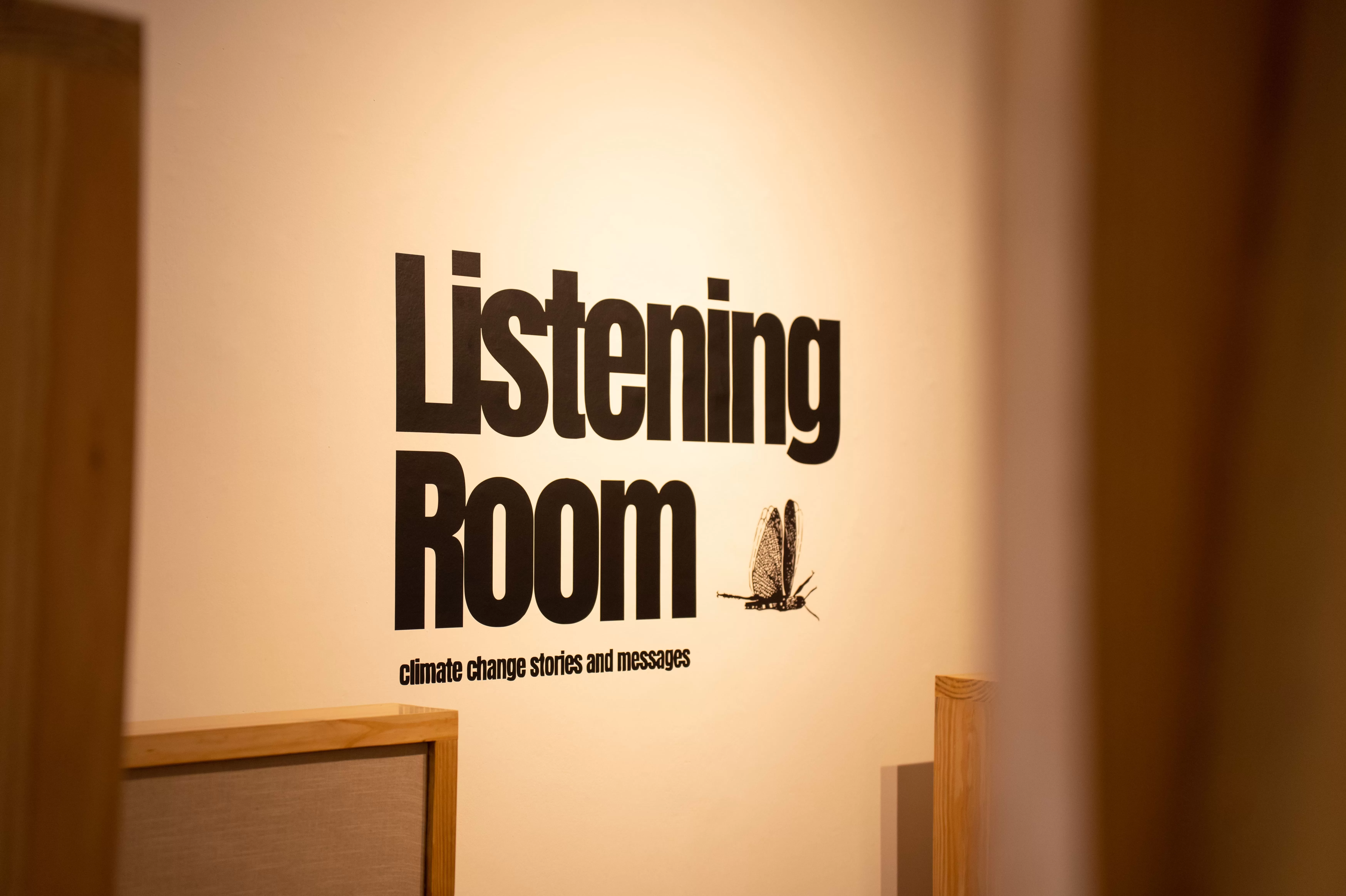
When sonic storyteller Tarun Balani began sharing climate-change inspired music through his now disbanded solo-project ‘Seasonal Affected Beats’, he found the message of the music being overshadowed by performative aspects. The music needed to have its own identity. He realised, “It needed a space where it eliminated the performer altogether. I feel like I was almost in the way of my own artistic output.” The ‘Listening Room’ was born as an intentional space dedicated to deep listening, sharing stories and messages about climate change. Created in collaboration with MONOM Studios, Berlin, installation architect Anant Mital, and powered by Amsterdam’s 4DSOUND – hailed as the world’s most advanced spatial audio sound system – Balani creates a malleable and potent deep-listening environment, and an introspective sonic experience for the audience.
For ‘Listening Room’, the music was designed specifically for spatial audio – a technology that aims to simulate the true listening experience by creating a multi-dimensional soundscape where the sound moves freely around the listener. The ensuing effect is a heightened sonic experience where the audience feels the music reverberate through their body. “In ‘Listening Room’ we have eight speakers – six speakers in a hexagonal spot and two subwoofers. For sound to truly move, you need physical speakers,” asserts Balani.The space invites the audience into an immersive journey of self-reflection through a twenty minute musical experience comprising the compositions ‘Beijing Dust Storm’, ‘The Earth Always Hums’, ‘2°’, and ‘Locusts Are Descending’. On the process of compiling the piece together, he says, “For this work, it was all improvised so I did it in single takes. I did break it up into a couple of live takes of this new piece called ‘Beijing Dust Storm’. But when I stitched the ‘Listening Room’ twenty minute piece together, placing the tracks together was the only production aspect of it in terms of editing.”
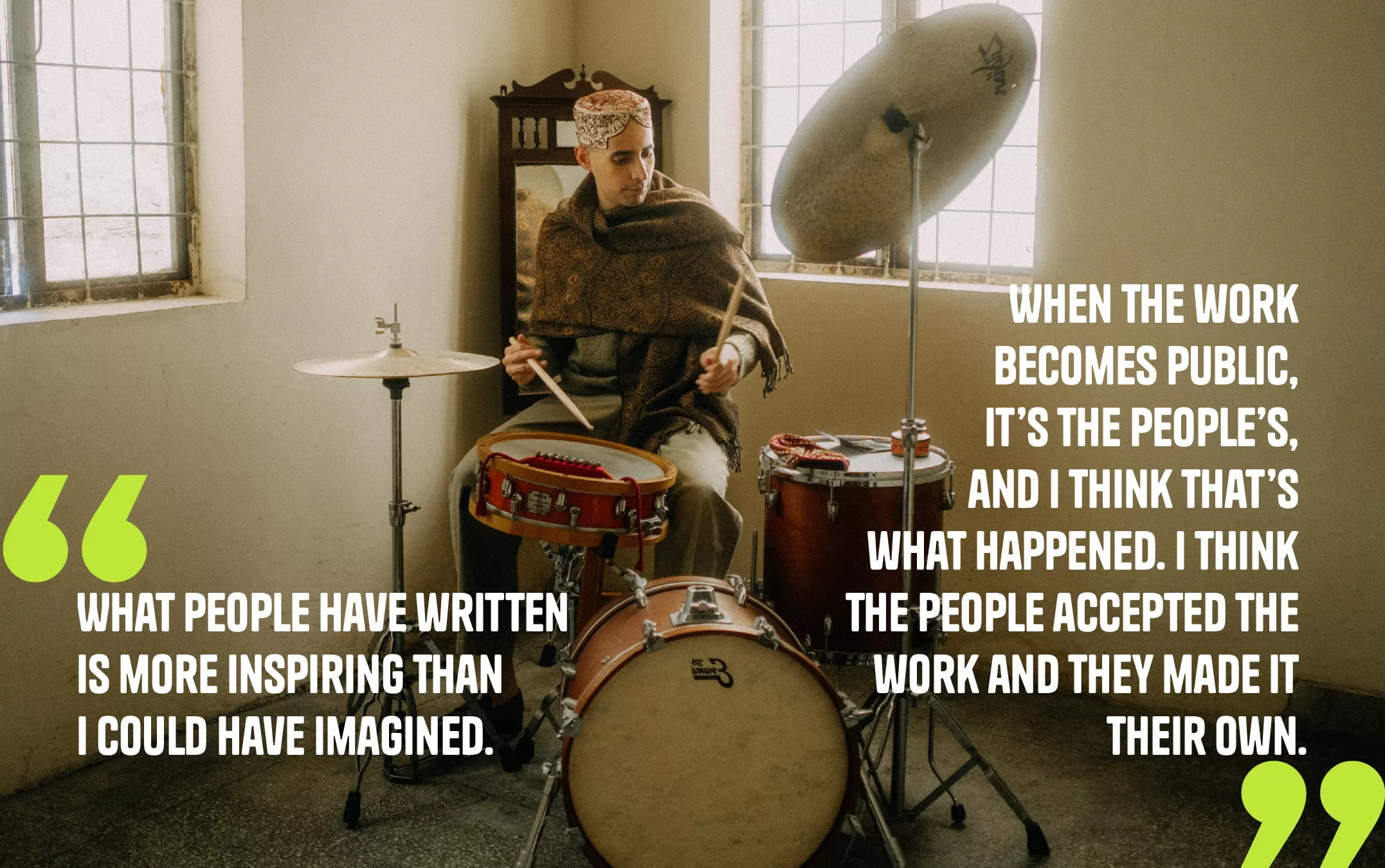
Creating a multi-sensorial experience in ‘Listening Room’, Balani has paired sound with touch and invited the audience to reflect on their relationship with climate by sharing their narratives through provided postcards. On the topic of postcards, he recollects, “I was feeling like there is so much more to this subject that is beyond my experience of climate change and people want to engage with this. The whole idea of the postcards was ‘How do I draw people in?’” Consequently, ‘Listening Room’ has become a “repository of people’s stories and messages about climate change.” Visibly moved remembering the audience’s overwhelming acceptance at the Goa edition in December 2024, Balani recalls the story of buying an extra suitcase to carry an additional 1500 postcards back home to Delhi. “What people have written is more inspiring than I could have imagined. When the work becomes public, it’s the people’s, and I think that’s what happened. I think the people accepted the work and they made it their own.” ‘Listening Room’ was exhibited at the ‘Young Collectors’ Hub’ at India Art Fair, New Delhi, in February 2024. Similar to its Goa edition, the ‘Listening Room’ installation received immense audience appreciation, reflected in many listeners returning to re-experience it multiple times during its course.
Socio-political themes have been a common thread across Balani’s discography from his very first album. However, it was the jarring apocalyptic reality of New Delhi’s smog-filled winter skies in the mid-2010s that made the climate crisis a focal point compelling Balani to create a sonic response, and weave this narrative into a body of work. “I simply had no choice. It was something that I simply had to just do. I started reading a lot about climate change, following authors like Amitav Ghosh who writes about climate change, and I started reading IPCC reports on climate change. I even did a course from the ‘Centre for Science and Environment’… So I think it became a very central figure in my voice and led to an output like ‘Listening Room’.” The work is also inspired by ‘Deep Listening’ by Pauline Oliveros which explores the technical aspects of listening, and how the experience of sound can impact a person at an individual, spiritual, physiological, and sociological level.
Noticeably, in his compositional work centred around climate change, including ‘Listening Room’, Balani has chosen to forego the use of lyrics and instead, picked the abstraction of sound as the primary language for storytelling. “Not using words is a choice so it is not absolute. When you remove lyrical content and you use a combination of pure acoustic sounds with electronic abstractions, it creates a sonic environment that is very malleable for you to drive a narrative- especially in my case for climate change. The electronic abstraction is really amazing because then people can interpret the music and the sound however they like.”
The aim of ‘Listening Room’ is multifaceted. Balani questions, “Are we truly listening? And if we are truly listening, are we truly listening to the world around us? Are we truly listening to each other? Are we truly listening to music? (I wanted to) generally create a space where people feel like, ‘Yes there is this space where I can be heard while also truly listening.’” Through ‘Listening Room,’ Balani strives to empower the audience to voice their climate stories and create a space where one can enhance their understanding of their relationship with their climate. “I truly believe that once people take charge of their own narrative of climate change and understand their relationship with climate change at a very deeply personal, and almost a very simple level, of ‘What is your relationship with your climate?’ – that’s where some social change can happen.” ‘Listening Room’ plays a facilitative role for the community to gather in hope and have, “a shared aspect of this very vast complicated subject.”
Whilst the thought of making a difference through his work has been on the forefront of Balani’s mind, he is starkly aware of the boundaries of his role as an artist. “If this can make a small change on some level – whether it is just at the smallest point of people feeling connected and thinking about climate change, to a policy change at some point, or helping somebody with data, I think I’ve done my job as an artist. Because my job is not to deliver the absolute. My job is to deliver and poke and ask the difficult questions, and it is for people to unravel the rest. My end goal is to continue to present art that moves me deeply and I truly hope that it moves people. That is my job at the end of the day.”
Balani has been connecting to audiences and broadening the horizons of his artistry with every output. His creative practice has been defined by his willingness to be on the edge and embrace discomfort. When the opportunity presented itself to produce the ‘Listening Room’ in immersive audio, he dove in head first. “I had never worked in immersive audio, and I was just like ‘How am I going to do this? I have one week in the studio, I have never met this engineer!’ But I like pushing myself so one aspect of it is pushing myself. Over the course of all these years, I think the core of my creative practice has been always relying on fundamentals that allow you to take these huge leaps and take calculated risks that will eventually land (you) in a place that is cool, hopefully.”
With greater acceptance of himself as an artist, his compositional style has evolved. Balani admits, “I’ve become a lot more confident in terms of saying a lot more with using a lot less. There is a lot of minimalism in my music now that is purely coming from a space where I just feel that I have nothing to prove, and I have no one to impress. This is who I am. This is how I write. This is how I like to speak.” A turbulent time of self-doubt and contemplation in 2024 proved to be a turning point, leading to a new-found clarity. He recounts, “I never listen to my records. But at that point in time, when I took a backseat and viewed my discography from a very emotional and very vulnerable perspective, I found a spine running through all of the records. I was like ‘I don’t think there’s a shred of doubt in my mind now that this is my voice.’ I almost saw myself in it.”
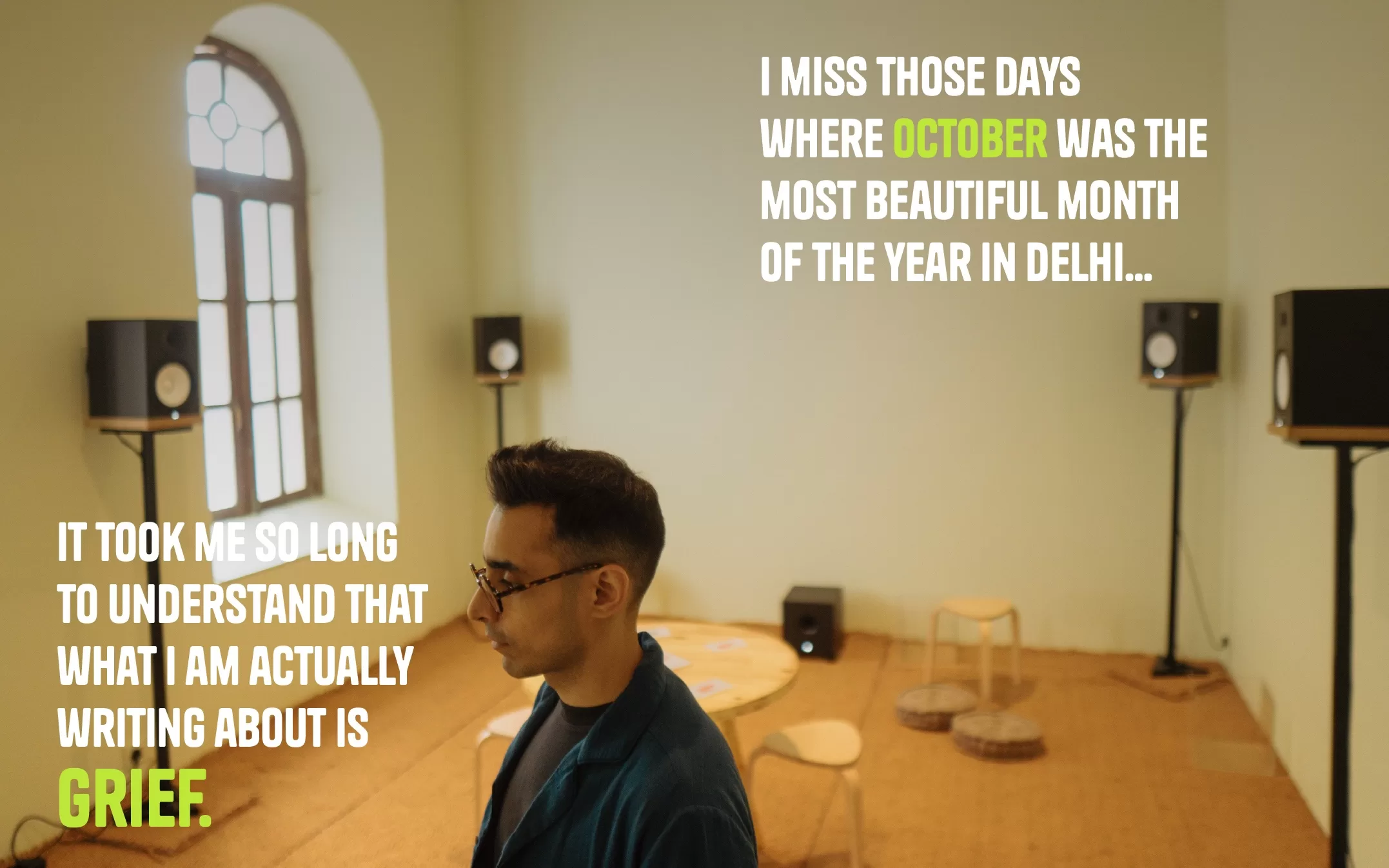
Composing music allows Tarun Balani to be nestled in a cocoon of safety and comfort in the face of the anxiety-inducing urgency of the climate crisis. “Making a sonic response is comforting for me – hundred percent. That’s why I am doing it. It is this expression where there is a release of all this anger, frustration, fear, memory… It took me so long to understand that what I am actually writing about is grief. It’s climate grief. I miss those days where October was the most beautiful month of the year in Delhi or I miss even an experience of winter where there was no smog.” The grief bleeds into, and colours the music with shades of melancholia but not without tinges of hope. “I think it’s all of it and I think one has to see it for all of it.”
Whilst it is easy to get disillusioned by the state of affairs surrounding the climate crisis, Balani navigates the collective disenchantment by tethering himself to a sense of hope. “You have to be hopeful. I think hope is the only drug that is going to get us through it. I think there is great resilience in us. My hope is to be more resilient and my hope is to carry people forward with me. And yes, is it difficult? Of course it is. But it’s just about taking that one step forward. What is a pretty strong aspect of my general practice, my musical mode and my mode in ‘Listening Room’ as well is one step forward and one step at a time,” concludes Balani. “Hopefully that proves to be what I’m intending it to be in maybe fifteen, twenty years time. Time will tell…”
Photo Credits: Mohit Kapil